• Skip to primary navigation
  • Skip to main content
  • Skip to primary sidebar

The History Of Watches

All you need to know about Luxury Timepieces

  • The Greatest Watch Heist – The return of The Brequet Queen
  • About Us
  • Contact Us
  • How you can choose the right watch
  • Japanese Watch History
  • The American Watch History
  • The Evolution of Watches: Tracking Time Across the Ages
  • The Greatest Watch Heist – The return of The Brequet Queen
  • Timekeeping in an ancient Egyptian temple
  • Watch Brand List
  • Watch Glossary
  • Watches Blog
  • The Greatest Watch Heist – The return of The Brequet Queen
  • About Us
  • Contact Us
  • How you can choose the right watch
  • Japanese Watch History
  • The American Watch History
  • The Evolution of Watches: Tracking Time Across the Ages
  • The Greatest Watch Heist – The return of The Brequet Queen
  • Timekeeping in an ancient Egyptian temple
  • Watch Brand List
  • Watch Glossary
  • Watches Blog

Archives for February 2023

Glycine history – one of military aviation and Air Force watch

February 28, 2023 by aabbady Leave a Comment

Glycine used extensively in commercial and military aviation. Glycine  used during World War II by the German army for its land forces and United States Air Force pilots during the Vietnam War and astronaut Pete Conrad during the Gemini 5 and Gemini 11 spaceflights.

The design allowed servicemen to simultaneously know the time at home and the local time while in combat. The Airman featured a date function, as well as a 24-hour dial and engraved, rotating 24-hour bezel with locking mechanism that allowed capability to tell time in two different time zones. Shortly after its military success.

In 1914

Swiss watchmaker founded in 1914 by Eugène Meylan  in Biel/Bienne, the manufacturing and headquarters at Switzerland.

In 1930

Glycine released the first mass-produced automatic watches

In 1942

Glycine owner Ferdinand Engel died and the company was turned over to Charles Hertig of the Altus Watch Company

Glycine’s in-house movement was acquired by ASUAG

In 1959

Glycine developed vacuum-sealed cases, allowing for more durable and water-resistant timepieces by Hans Ulrich Klingenberg, working for them

in 1963

Altus and Glycine merge

In 1980

Through a series of mergers, ASUAG will become part of The Swatch Group to join elite group including Omega, Longines, and Hamilton

In 1984

Hans Brechbühler, a businessman in the watch industry, purchased Glycine and join by his daughter Katharina.

In 2000

The father-and-daughter duo released the Airman 7 designed for pilots in the United States. it was the first watch available with four time zones of the contiguous United States.

In 2005

Katharina assumed sole control of Glycine.

In 2010

After Hans Brechbühler died in 2010 Katharina sold Glycine to Altus Uhren Holding AG andshe remained with the company to supervise design.

Altus, Glycine re-released the Airman in its original 36 millimeter case size as the Airman No. 1 and released a 60th anniversary Airman AM/PM model.

In 2016

Invicta Watch Group purchased Glycine

Please remember that this is an unofficial account of the history of this
company, Should you happen to find any mistakes with our information then
please let us know at

Email
Us

Filed Under: Luxury Timepieces Tagged With: luxury pieces, Luxury Timepieces, Old watches, Timepieces., Vintage watches, watches, watches history

Glashütte watches history – The German luxury watch

February 28, 2023 by aabbady Leave a Comment

Glashütte Original watches are one of the most highly respected luxury watch brands within the watchmaking community. Each Glashütte Original timepiece offers a unique balance of premiere elegance and innovative functionality.

For nearly two centuries, the German luxury watch manufacturer Glashütte Original has stood for exceptional quality and an expert eye for detail. Although it’s difficult to limit a list to only ten, here are our ten reasons why we – along with many watch enthusiasts around the world

In 1845, the first watchmakers began to settle in Glashütte, with the help of a loan from the Kingdom of Saxony. they began to train the people in the town, who then became independent watchmakers.

Glashütte watches is extremely well respected and I certainly consider them generally equivalent to their Swiss counterparts.

This laid the cornerstone for the Saxon watch industry and the outstanding quality of Glashütte watches which gained a worldwide reputation. In order to preserve this knowledge for the future, the German School of Watchmaking Glashütte was founded in 1878.

The changes to the economic system led to the merger of all existing Glashütte watchmaking companies in July 1951.

After German reunification, the Glashütter Uhrenbetrieb GmbH was entered into the commercial register on 16th October 1990. The company became the official legal successor to the majority of the watchmaking enterprises that had existed in Glashütte since the end of the Second World War.

In 2000, Glashütte Original became part of the Swatch Group. This watch group – the largest in the world.

Today, Glashütte Original is synonymous with the pinnacle of the German art of watchmaking. Almost 95% of all their watch parts are manufactured in-house, including their filigree dials.

Over the years, Glashütte Original has nurtured a culture based on excellence, the results of which are clear to see in the timeless elegance and sophisticated technology of the company’s timepieces.

Please remember that this is an unofficial account of the history of this
company, Should you happen to find any mistakes with our information then
please let us know at

Email
Us

Filed Under: Luxury Timepieces Tagged With: luxury pieces, Luxury Timepieces, Old watches, Timepieces., Vintage watches, watches, watches history

Girard-Perregaux watches history

February 27, 2023 by aabbady Leave a Comment

In 1791

Jean-François Butte began crafting high-end timepieces.

In 1852

when Constant Girard founded the company Girard & Campagnie.

In 1856

He marry Marie Perregaux, a member of an established family of watchmakers from Le Locle.              The respective surnames of the couple were combined to form Manufacture Girard-Perregaux, This name lives on to this day.

In 1860

Girard created a pocket watch equipped with a tourbillon and three parallel bridges which received a first class award from the Observatory of the Canton of Neuchâtel.

In 1883

the styling of the bridges arrow like tips featured on the three bridges for the first time. This design was later patented in the United States. The shape of the three golden bridges has remained relatively consistent since this period, becoming part of the Girard-Perregaux paradigm.

In 1966

Girard-Perregaux released its first high frequency movement. The balance wheel oscillated to and fro at 36,000 vibrations per hour (5 Hz). The increased frequency of the movement conferred greater accuracy.

In recognition of the research and development undertaken by Girard-Perregaux, the Administrative Council of Neuchâtel chose to recognise its achievements by awarding the Observatory Centenary Prize

collection of recent years has included chronographs, dual-time watches and full-calendar timepieces. Irrespective of the model selected, each watch exhibits a tasteful quotient of style.

In 1970

A famous pocket watch created by Constant Girard was “La Esmeralda”. Arguably the most celebrated timepiece he was responsible for, it bore his monogram and an enamel dial. The watch is said to have been given to the President of Mexico

In 2011

The Swiss holding group of Girard-Perregaux, Sowind Group, has been a subsidiary of the French luxury group Kering. Headquartered in La Chaux-de-Fonds, Switzerland, the company opened the Girard-Perregaux Museum near its headquarters in Villa Marguerite in 1999

In 2013

The Girard-Perregaux scooped further silverware with its ingenious Constant Escapement L.M. The watch won the GPHG, Grand Prix D’ Horlogerie de Geneva, “Aiguille d’Or”, the most coveted prize in the watchmaking field.

In 2014

the Swiss brand adapted the three bridge design for a modern audience, releasing the Neo-Tourbillon with Three Bridges. In this instance, the bridges were made of titanium, sandblasted and treated with black PVD, evincing a contemporary air.

Please remember that this is an unofficial account of the history of this
company, Should you happen to find any mistakes with our information then
please let us know at

Email
Us

Filed Under: Luxury Timepieces Tagged With: luxury pieces, Luxury Timepieces, Old watches, Timepieces., Vintage watches, watches, watches history

Universal Genève watches history

February 27, 2023 by aabbady Leave a Comment

Genève watches Swiss luxury watch company founded in 1894 based in Le Locle by co-founder Ulysse Perret as Universal Watch. From beginnings, the company has produced complete watches with in-house movements’.

Throughout the 20th century, distributed many notable and important timepieces. Along with neighboring Geneva great timepieces watch companies, Universal is internationally regarded for its style of craftsmanship and manufacture.

The brand makes historical claim for creating the first-ever chronographic wristwatch in 1917.

After the pocketwatch started to lose usefulness in favor of the more convenient wristwatch during the first world war, Universal seized the opportunity by creating the Compur in 1933 and the Aero Compax (“Aviator’s Compact Chronograph”) in 1936 which made it a suitable device for soldiers.

1894

The origins

Talented watch makers Numa Emile Descombes and Ulysse Georges Perret, found a company specializing in making complicated watches. Foreign trade develops rapidly and products are enthusiastically received

1897

Early successes

Descombes dies and Perret associates with Louis Edouard Berthoud in making complete pocket-watches. In 1898 they present a chronograph with 30-counter, the Universal Watch Extra, and subsequently release their first wristwom chronograph in 1917.

1934

A legend in the making

The company is renamed Universal Watch, relocates to Geneva and enjoys impressive and international growth. A succession of elegant and complicated models — the Compax, Aero-Compax and Tri-Compax (1930-40), Polerouter (1954) and Microtor UG66 (1966) — leave and indelible imprint on their area

1960’S

A brand on the move

In keeping with its taste for innovation, Universal Genève launches the world’s thinnest quartz calibre in 1975. During the 1980s and 90s, the brand enjoys an impressive international reputation and its represented in South-East Asia, the Middle East and Italy.

2005

Renewal

While the 2005 and 2006 models reinterpret the house design in harmony with the Universal Genève spirit, the arrival of the Microtor UG100 and the series-production launched in 2007 of the Calibre UG101 provide powerful confirmation on the brand renewal.

2008

Another bold next release

On the occasion of Baseworld 2008, and 80 years after the launch of its first reversible watch, the Cabriolet, Universal Genève presents the Microtor Cabriolet, the first shaped timepiece (since the brand’s renewal) distinguished by a daring and contemporary spirit.

1894

January 18th, creation in Le Locle of the Decombes & Perret watch company headed by Numa Emile Descombes (1863-1897) and Ulysse Georges Perret (1868-1933).

1925

Two international patents (N° 91051 and 91463) are registered for the Auto-Rem, the first self-winding wristwatch by Univesral (a mechanism equipped with buffers).

1927-1929

Presentation of the Cabriolet model and of watches endowed with an 8-day power reserve.

1934

Creation of the double push-button Compur chronograph wristwatch (a trademark registered under patent N°83340); the first movement used is equipped with two column wheels.

1935

Launch of the Compax chronograph wristwatch with 12 hour and 30 minute counters.

1936

Presentation of the Uni Compax chronograph wristwatch with 45 minute counter.

1937

Universal Watch Co. Ltd is renamed Universal Genève. Creation of the smallest ladies chronograph wristwatch of the era, equipped with a 19 1/2” movement.

1940

Launch of the Aero-Compax (patent N° 235608). This is a Compax chronograph equipped with a fourth subdial featuring hour and minute hands at 12 o’clock and enabling the user to memorise the start of an operation by means of an additional crown at 9 o’clock.

1943

Universal Genève presents the calendar watch, with or without moon-phase display, showing the small seconds at 9 o’clock, the day at 12 o’clock and the months and moon phases at 6 o’clock.

1944

Manufacture des Montres Universal, Perret & Berthould SA Genève. To commemorate its 50th anniversary, the company presents its latest launch: the Tri-Compax. This hour counter chronograph with triple-date calendar and moon-phase display is to become one of watchmakings’s greatest.

1945

Introduction, within the Compax range, of the Medico-Compax, a chronograph featuring an hour counter bearing a pulsometric scale; and of the Dato-Compax, a chronograph with our counter fitted with a 4th subdial at 12 o’clock indicating the date from 1 to 31.

1954-1955

Launch of the Polerouter or Polarouter. SAS (Scandinavian Airlines System) makes the inaugural flight along the first air route between Europe and the United Stats to accross the North pole. The crew is equipped with a high-precision self winding watch (Cal. 138) capable of withstanding the powerful magnetic fields around the Pole.

1955

Creation of the Microtor (patent N°329805), a new type of self-winding movement with oscillating weight integrated within the movement (Calibre 215).

1963

Presentation at the Basel Fair of the Universal Genève Railrouter and Polerouter Electric models.

1966

Launch of the Golden Shadow, the world’s thinnest self-winding watch, driven by Calibre 66 and Calibre 67 with date display (2.5 mm thick).

1968

Introduction of the Tuning Unisonic, a watch with a tuning-fork type frequency regulator.

1975

At the Basel Fair the brand presents the Calibre 74, the world’s thinnest analog-display quartz driven movement (just 3.45mm).

1994

To celebrates its centenary year, Universal Genève launches a world first (UG Calibre 42-83/4”): the Janus watch, inspired by the Cabriolet model. Its reversible dial features a single movement allowing one to read off the time on two dials, including one with jumping hours.

2005

Universal Genève launches two new collection: Okeanos (for men) and Anthea (for ladies).

2006

Presentation at Baselworld of four new moels: the Microtor UG 100, the Okeanos Compax, the Okeanos Aero-Compax and the Okeanos Moon Chronograph.

2007

Presentation at the Baselworld of three new steel men’s watches: the Microtor UG 101 (self winding proprietary movement), now produced in series; the Uni-Timer, with two counter chronograph Calibre UG 71.5; and the Timer Chronograph, with three-counter Calibre UG 71.6, the two latter being equipped with and openworked oscillating weight. For ladies, the Anthea steel watch is available in two new jewelry versions: one set with 46 brilliant-cut diamonds and the other with 132 brilliant cut diamonds.

2008

Universal Genève presents the Microtor Cabriolet, a new timepiece inspired by the Cabriolet, the first reversible watch launched by the brand in 1928. A daringly shaped model in a decidedly masculine spirit and a marvel of mechanical ingenuity, the Microtor Cabriolet is driven by the signature Microtor UG 101 movement and is distinguished by its impressively understand design. Meanwhile, another new release sees the Microtor UG 101 welcoming a new dial and an exclusive steel bracelet.

… TODAY

Universal Genève continues to offer chronographs and keep a quality after-sales service. Our watches are, in particular, available for order on City Chain Hong-Kong. Universal Genève watches are also available in Singapore, Thailand, China and Malaysia.

From the company website

https://universal.ch/en/about-us/history-and-chronology/

Please remember that this is an unofficial account of the history of this
company, Should you happen to find any mistakes with our information then
please let us know at

Email
Us

Filed Under: Luxury Timepieces Tagged With: luxury pieces, Luxury Timepieces, Old watches, Timepieces., Vintage watches, watches, watches history

Gauthier watches history

February 27, 2023 by aabbady Leave a Comment

Romain Gauthier was born in 1975 in the Vallée de Joux, Switzerland, the cradle of fine Swiss watchmaking. It was here that Romain developed his passion for traditional Haute Horlogerie, his grasp of mechanics and engineering, and his eye for design. Having specialised in precision mechanics at technical college, Romain qualified as a constructor of precision machinery in 1997.

A year later, he started his first job as machine programmer-operator at a horological components manufacturer that he helped turn into one of the best-performing facilities in Europe.

Determined to build from scratch not just his own high-end watch, but also his own high-end watch brand, Romain completed an MBA in 2002. His final thesis was the business plan for his own watch company. After working behind closed doors on his own timepieces for three years, he launched the Romain Gauthier brand in 2005, unveiling its first timepiece, Prestige HM, at Baselworld 2007.

This was followed by Prestige HMS (2010), Logical One (2013), Logical One Secret (2014) and Insight Micro-Rotor (2017). These encompass classically refined pieces, contemporarily casual creations and ethereal objets d’art, all featuring supremely finished in-house movements. In 2013, the jury of the Grand Prix d’Horlogerie de Genève – the Oscars of watchmaking – awarded Romain Gauthier’s Logical One the prize for Best Men’s Complication.

Romain Gauthier’s ability to create exquisite timepieces is in large part thanks to his manufacture, based in Le Sentier, Switzerland, that he has steadily built up.

The manufacture employs skilled craftsmen and time-honoured watchmaking tools alongside experienced technicians and cutting-edge production methods, allowing Romain Gauthier to design, produce, decorate, assemble and regulate in-house all movements for the brand’s timepieces.

KEY DATES

1998

At technical college, Romain finds his forte: making machine parts on lathes. He specialises in precision mechanics and, on graduating, starts his first job as a machine programmer-operator at a horological components factory.

1999

Romain reflects on his Vallée de Joux roots, grasp of engineering and ability to make components, and he asks himself why he has not yet tried designing his own watch. In his free time, he begins work on designs that become more and more elaborate.

2000

Romain sets his sights on building not just his own watch but also his own watch brand. He studies for an MBA in his spare time to get the know-how he will need. His final thesis is the business plan for his watch company.

Romain Gauthier et Philippe Dufour

2002

Romain visits watchmaker Philippe Dufour to see if, in the modern age, one person can still create a movement on their own. Inspired, Romain is even more determined to pursue his dream of creating his own watch and brand.

Mouvement Romain Gauthier

2002

Impressed by Romain’s design and ambition, his boss grants him after-hours access to the factory’s tools and machines so he can develop parts for his movement. Over three years, Romain spends evenings, weekends and holidays doing just that.

2005

Romain sets up his eponymous company in Le Sentier, Switzerland. Within the first year he employs his first watchmaker to hand-finish and assemble the movement he has been working on, Calibre HM 2206.

HM 2206

2007

Calibre HM 2206 powers Romain’s first watch, Prestige HM, which the brand presents at its debut Baselworld. The show is a success. Exuding all the traits of fine Swiss watchmaking, Prestige HM is the first piece to grace the Romain Gauthier Heritage collection.

2008

To complement the brand’s watchmaking atelier, Romain invests in a number of automatic lathes and sets up a team of production specialists to ensure that Romain Gauthier movements can continue to be developed entirely in-house.

Prestige HMS

2010

Launch of Prestige HMS, an evolution of Prestige HM with added seconds and a more contemporary aesthetic, including a partly openwork dial.

Prestige HMS Natural Titanium

2011

Launch of Prestige HMS Natural Titanium, the brand’s first watch in titanium, launching Romain Gauthier’s Freedom collection of timepieces featuring high-tech materials and a more casual style.

Logical One

2013

Featuring Romain’s revolutionary constant-force movement with ruby-link chain and push-button winding, Logical One is launched to much acclaim and puts Romain Gauthier on the horological map. Logical One wins the prize for Best Men’s Complication Watch at the Grand Prix d’Horlogerie de Genève.

Logical One Secret Diamonds

2014

Logical One Secret Diamonds is launched and begins Romain Gauthier’s Exception collection of unique pieces lit up by virtuoso displays of decorative crafts.

Le Sentier, Suisse

2014

Romain Gauthier brings production and watchmaking operations together at a brand-new, purpose-built manufacture in Le Sentier.

Prestige HMS Black Titanium, Logical One Natural Titanium et Black Titanium

2016

The launches of Prestige HMS Black Titanium, Logical One Natural Titanium and Black Titanium, plus ‘Enraged’ limited editions of Logical One and Prestige HMS, ensure the growth of the Romain Gauthier Freedom collection.

Insight Micro-Rotor

2017

Boasting a finely-finished in-house calibre featuring a bidirectional micro-rotor and 80-hour power reserve, Insight Micro-Rotor – Romain Gauthier’s first automatic timepiece – is launched.

From the company website

https://www.hautehorlogerie.org/en/watches-and-culture/partner-brands/history/h/romain-gauthier/

Please remember that this is an unofficial account of the history of this
company, Should you happen to find any mistakes with our information then
please let us know at

Email
Us

Filed Under: Luxury Timepieces Tagged With: luxury pieces, Luxury Timepieces, Old watches, Timepieces., Vintage watches, watches, watches history

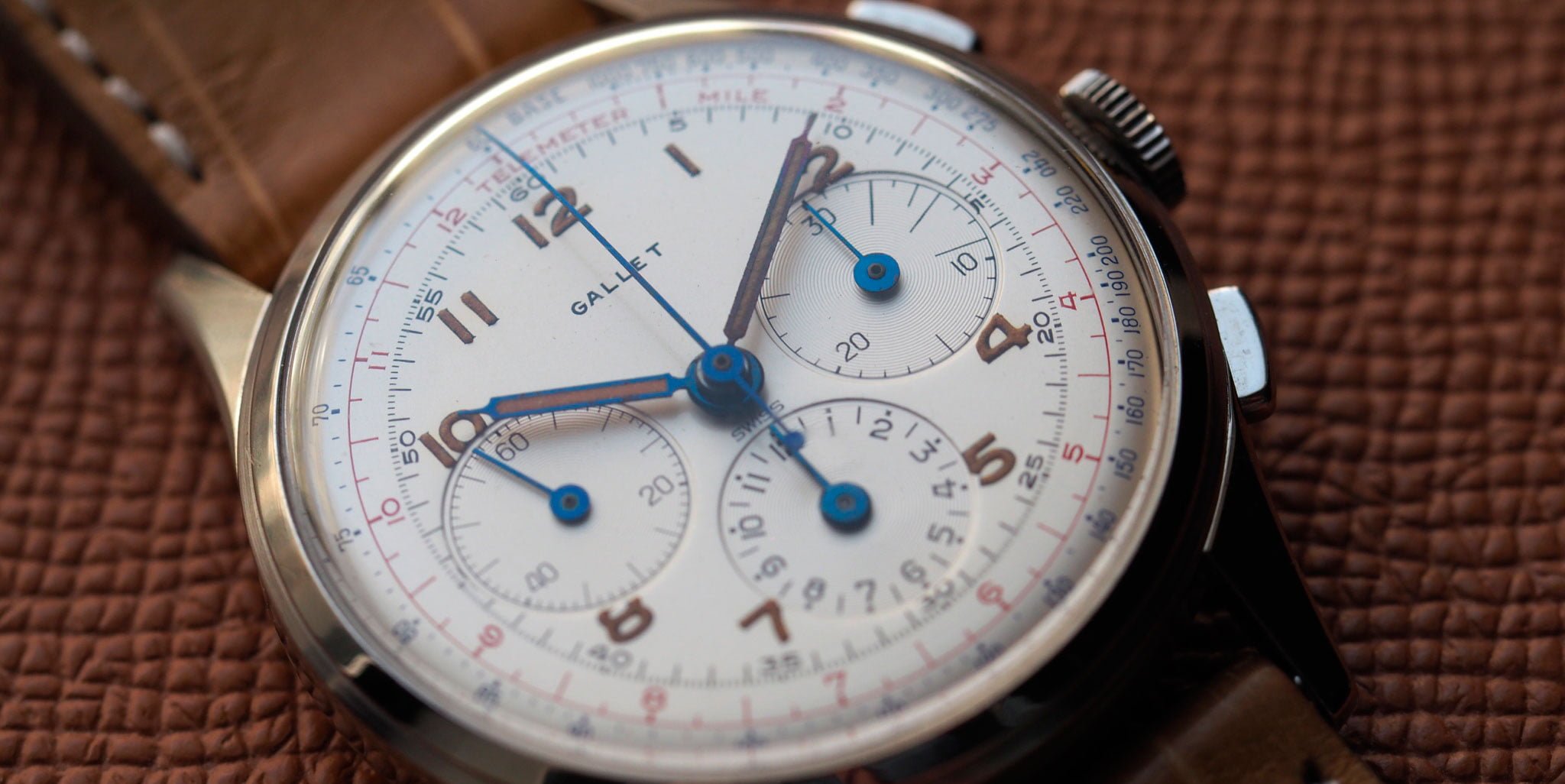
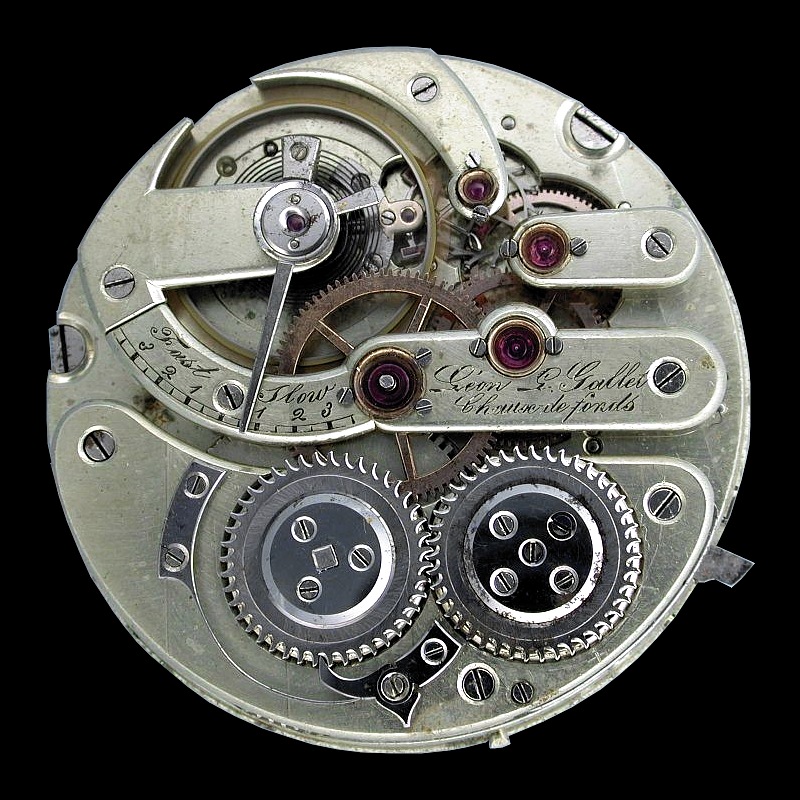
Gallet History Time Line

February 25, 2023 by aabbady Leave a Comment

Gallet History Time Line


1466


Humbertus Gallet, living and working in Geneva, becomes a
citizen of the republic on the 18th of April. Historical references point to
his profession as a horloger or clock maker.


1685


Due to the abolishment by French King Louis XIV of the
tolerance agreement of Nantes, additional members of the Bourg-en-Bresse Gallet
family, whose professions are documented as goldsmiths and watchmakers, join
their relatives in Geneva to live and practice their trade.

1702 – Philippe Gallet ((1679–1739), son of Jacques Gallet
(1649–1700) and Marie Bouvier Gallet, is included in the Geneva Registry of
Jewelers and Watchmakers.

Gallet History watches history


1742


Pierre Gallet (1712–1768) marries noblewoman Jeanne Renée de
Rabours. The marriage contract records Pierre Gallet’s profession as master
goldsmith. This document also lists the occupation of Pierre’s father, Philippe
Gallet (1679–1739), as goldsmith and watchmaker.


1744


Jeanne Renee gives birth to a son, Jacques, who follows in
his father’s occupation as jeweler and watchmaker.

Gallet History watches history


1774


Jacques Gallet (1745–1806) fathers a son, Jean-Louis Gallet
(1774–1809).


1804


Napoleon annexes Geneva, naming it the Lemanique Republic.
Jean Louis Gallet becomes a French citizen and continues his father’s jewelry
and watch making company until his pre-mature death in 1809 at age 35.

Gallet History watches history


1826


Julien Gallet (1806–1849), son of Jean Louis, relocates the
family watch making business to La Chaux-de-Fonds, a major center for pocket
watch production. At this time, the company is officially registered as Gallet
& Cie (Gallet & Company), a break from the tradition of naming the
business after the family patriarch.

Gallet History watches history

1848


Julien Gallet dies at 43, after which, the company is run by
his widow Louise, and

sons Leon and Lucien.


1855


Léon Gallet (1832–1899) becomes the patriarchal figure of
the rapidly growing Gallet & Cie. He expedites the expansion of the company
and the need for more workshop space by acquiring Grumbach & Co., which
produces watches with the brand name Electa. Gallet & Cie. is renamed
Electa Gallet & Cie. and produces watches under both the Gallet and Electa
brand names.

Gallet History watches history


1864


Léon Gallet’s brother Lucien Gallet establishes the
company’s first US location in Chicago, with a New York City office following
soon after. Together with Jules Racine, a cousin of the Gallet brothers living
in the US, the company expands its distribution to the American market.


1876


In response to competition for sales of timepieces in Europe
by large American watch manufacturer’s, Léon Gallet, together with Louis and
Jules Courvoisier, Ernest Francillon of Longines, and Constant Girard-Gallet of
Girard-Perregaux, found the “Intercantonal Company for Industrial Development
of the Jura Industries”. Benefiting from the unified strength of combined
Swiss manufacturing resources, the group is able to maintain its sales
dominance in Europe. Marketing for the syndicate is primarily European based
with an emphasis on sales to England.

Gallet History watches history


1880


Henriette Gallet (1860-1939), daughter of Léon Gallet, is
wed to Émile Courvoisier (1858-1937), son of Louis Courvoisier (1825-1885), at
which time the working relationship between these two important La
Chaux-de-Fonds watch manufacturers becomes familial.


1881


Léon L. Gallet commissions and trademarks the Gallet Lyre
Mark. The Lyre Mark is stamped on watch cases and movements manufactured in the
La Chaux-de-Fonds workshop.

Gallet History watches history


1882


A strategic partnership is formed with Jules Jeanneret &
Fils, to supply mechanisms for Gallet’s professional use line of hand-held
timers and pocket chronographs.


1883


Léon hands over management of the Gallet company to his
older son Julien (1862–1934), but continues to remain involved until his 1899
death in New York. The JG initials are added to the Gallet Lyre Mark and the
company name is temporarily changed to Julien Gallet & Cie to reflect the
older son’s control of the business. Georges Gallet (1865–1946), Léon’s younger
son, assists his brother with the management of the company while working
part-time at Courvoisier & Frères. By this time, the Gallet Company is
producing more than 100,000 watches annually.

Gallet History Time Line

1466

Humbertus Gallet, living and working in Geneva, becomes a citizen of the republic on the 18th of April. Historical references point to his profession as a horloger or clock maker.

1685

Due to the abolishment by French King Louis XIV of the tolerance agreement of Nantes, additional members of the Bourg-en-Bresse Gallet family, whose professions are documented as goldsmiths and watchmakers, join their relatives in Geneva to live and practice their trade.
1702 - Philippe Gallet ((1679–1739), son of Jacques Gallet (1649–1700) and Marie Bouvier Gallet, is included in the Geneva Registry of Jewelers and Watchmakers.

1742

Pierre Gallet (1712–1768) marries noblewoman Jeanne Renée de Rabours. The marriage contract records Pierre Gallet's profession as master goldsmith. This document also lists the occupation of Pierre's father, Philippe Gallet (1679–1739), as goldsmith and watchmaker.

1744

Jeanne Renee gives birth to a son, Jacques, who follows in his father's occupation as jeweler and watchmaker.

1774

Jacques Gallet (1745–1806) fathers a son, Jean-Louis Gallet (1774–1809).

1804

Napoleon annexes Geneva, naming it the Lemanique Republic. Jean Louis Gallet becomes a French citizen and continues his father's jewelry and watch making company until his pre-mature death in 1809 at age 35.

1826

Julien Gallet (1806–1849), son of Jean Louis, relocates the family watch making business to La Chaux-de-Fonds, a major center for pocket watch production. At this time, the company is officially registered as Gallet & Cie (Gallet & Company), a break from the tradition of naming the business after the family patriarch.

1848

Julien Gallet dies at 43, after which, the company is run by his widow Louise, and 
sons Leon and Lucien.

1855

Léon Gallet (1832–1899) becomes the patriarchal figure of the rapidly growing Gallet & Cie. He expedites the expansion of the company and the need for more workshop space by acquiring Grumbach & Co., which produces watches with the brand name Electa. Gallet & Cie. is renamed Electa Gallet & Cie. and produces watches under both the Gallet and Electa brand names.

1864

Léon Gallet's brother Lucien Gallet establishes the company's first US location in Chicago, with a New York City office following soon after. Together with Jules Racine, a cousin of the Gallet brothers living in the US, the company expands its distribution to the American market.

1876 

In response to competition for sales of timepieces in Europe by large American watch manufacturer's, Léon Gallet, together with Louis and Jules Courvoisier, Ernest Francillon of Longines, and Constant Girard-Gallet of Girard-Perregaux, found the "Intercantonal Company for Industrial Development of the Jura Industries". Benefiting from the unified strength of combined Swiss manufacturing resources, the group is able to maintain its sales dominance in Europe. Marketing for the syndicate is primarily European based with an emphasis on sales to England.

1880

Henriette Gallet (1860-1939), daughter of Léon Gallet, is wed to Émile Courvoisier (1858-1937), son of Louis Courvoisier (1825-1885), at which time the working relationship between these two important La Chaux-de-Fonds watch manufacturers becomes familial.

1881

Léon L. Gallet commissions and trademarks the Gallet Lyre Mark. The Lyre Mark is stamped on watch cases and movements manufactured in the La Chaux-de-Fonds workshop.

1882

A strategic partnership is formed with Jules Jeanneret & Fils, to supply mechanisms for Gallet’s professional use line of hand-held timers and pocket chronographs.

1883

Léon hands over management of the Gallet company to his older son Julien (1862–1934), but continues to remain involved until his 1899 death in New York. The JG initials are added to the Gallet Lyre Mark and the company name is temporarily changed to Julien Gallet & Cie to reflect the older son's control of the business. Georges Gallet (1865–1946), Léon's younger son, assists his brother with the management of the company while working part-time at Courvoisier & Frères. By this time, the Gallet Company is producing more than 100,000 watches annually.

1893

Berthe Courvoisier (1868-1936), daughter of Louis Philippe Courvoisier and an heir to the family watch company, is wed to Georges Gallet, son of Léon. Berthe Courvoisier and her brother Émile, together with Georges Gallet and his sister Henriette, continue to manage the Courvoisier Frères watch company. Georges Gallet assumes the role as co-director of the company.

1895

Gallet introduces the first wrist-worn watches for mass consumption by men and women to the American market. These first "wristwatches" are immediately rejected due to public perception as being too unusual for women and too feminine for men. All unsold examples are soon returned to Switzerland for disassembly. In spite of initial resistance to this groundbreaking innovation, wristwatches are issued during WWI as a more useful way for soldiers to tell time in combat situations. As a result, this new concept gains acceptance, and is soon added to the offerings of numerous other watch companies.

1896

Rail road pocket watches with chronometer grade movements with patented regulators are created by Gallet under the Interocean brand name and distributed by Timothy Eaton (T. Eaton Department Store) for railway use.

1896

Gallet wins a silver medal at the Swiss National Exhibition in Geneva.

1899

Upon his death, Léon Gallet bequeaths a sum of 43,000 Swiss Francs (today equivalent to approx. 1,000,000 US dollars) to the town of La Chaux-de-Fonds, of which 25,000 Swiss Francs is used for the construction of the Musée international d'horlogerie (International Museum of Watch Making). To assist the museum in building its initial collection of timepieces, Georges Gallet donates over 100 highly complex and valuable Gallet, Electa, and Courvoisier watches. Georges Gallet serves as director of the museum for the next twenty years.

1900

Shortly after Léon Gallet's death, the company name is changed back to Gallet & Cie (Gallet & Co.).

1905

Gallet wins a Diploma of Honor at the Liege Exhibition.

1906

The company name "Gallet & Cie, Fabrique d’horlogerie Electa" is registered to reinforce Gallet's ownership and control of the Electa brand. Under the Electa name, Gallet produces its highest quality timepieces.

1911

Henri Jeanneret-Brehm, a member of the esteemed Jeanneret family of St. Imier watchmakers, purchases the Magnenat-Lecoultre factory with financial assistance from the Gallet company.

1912

Gallet creates the first wristwatch for mass distribution to include a full-sized constant seconds hand originating from the center of the dial (face). This innovation proved useful for timing tasks that emphasized seconds over minutes and hours, including the measuring of the human heart rate. Gallet’s new “sweep second” wristwatches were issued to military nurses and medics during World War I.

1914

Gallet wins the Grand Prize in the Chronometer category at the Swiss National Exhibition in Berne.

1915

Gallet supplies hand held and cockpit mounted timers to the British Air Force during WW I.  Movements are produced in Gallet’s Electa workshop and marked with the Electa name.

1916

Gallet supplies wrist-worn timers to the British armed forces during World War I. This early chronograph wristwatch was an obvious transitional timepiece. While technically refined and reduced in size from a traditional hand-held timer, it still retains the three-piece case, porcelain enamel dial, and center button crown of its larger predecessor.

1917

Gallet wins the 1st place award for chronometer accuracy at the Canton Observatory in Neuchâtel.

1918

Jeanneret-Brehm begins manufacturing under the company name Excelsior Park. Deriving the name from Jenneret-Brehm’s previously registered “Excelsior” trademark, the English variation of the French word for “park” is utilized at the prompting of Gallet to support the collaborative efforts of the two companies in their marketing focus on the American consumer. The cooperative relationship of Excelsior Park and Gallet leads to the development of a number of time recording mechanisms, including the calibre 40. These new chronograph movements are utilized almost exclusively in Gallet and Excelsior Park wristwatches, with a small number supplied to the Girard Perregaux and Zenith companies when production capabilities allowed.

1927

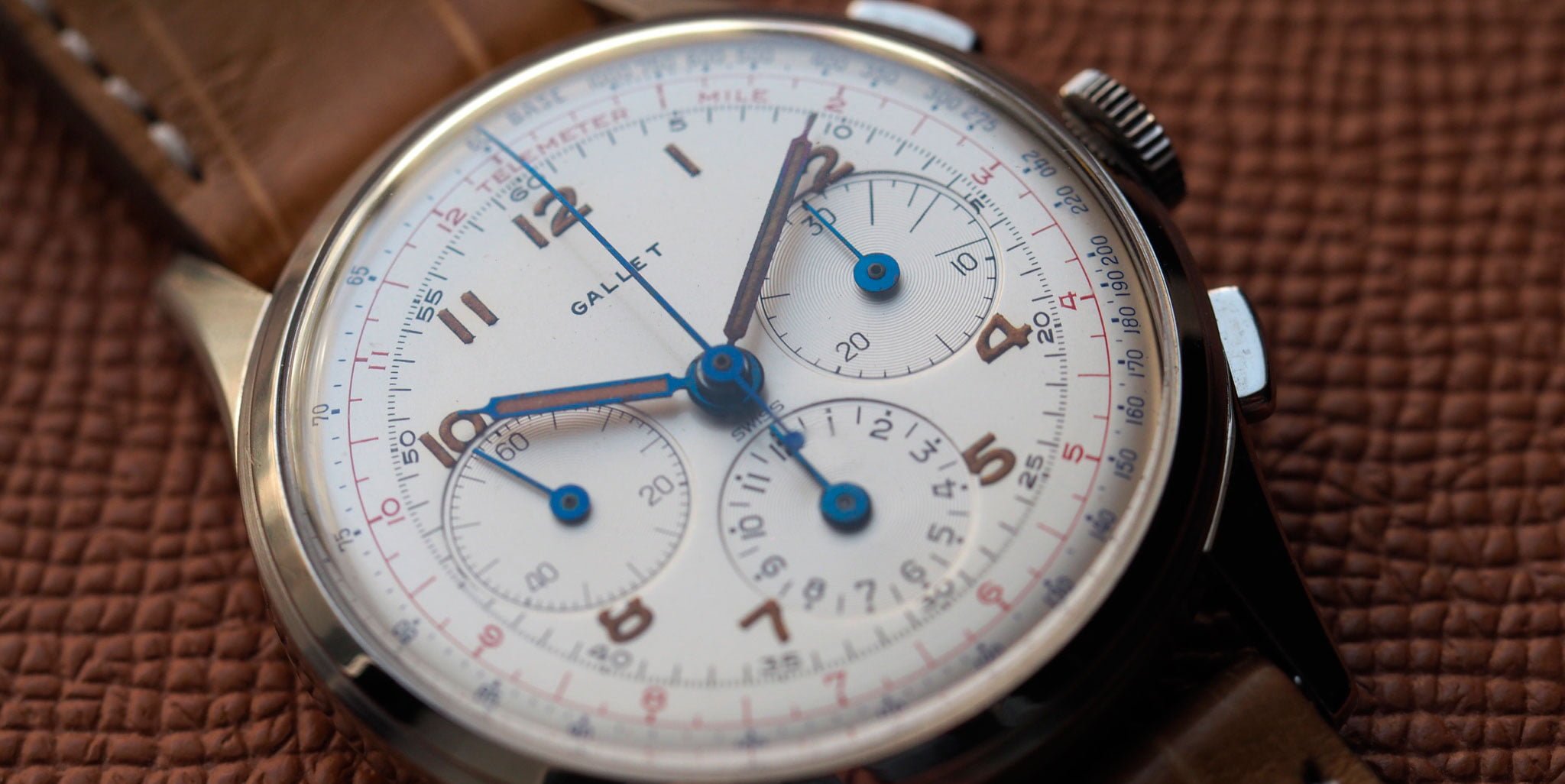
Gallet introduces the “Regulator” and “Duo Dial” wristwatches for the medical and technical professions. The large-sized lower subsidiary seconds dial of the rectangular Duo-Dial and the predominant resetting sweep-second hand of the Regulator simplify the task of calculating a person’s per-minute heart rate.

1929

While Gallet develops viable markets for its new wristwatch innovations, the company is able to survive the Great Depression by supplying professional use “tool watches” to its military and industrial clients.

1935

As World War II becomes imminent, Gallet begins production of wristwatches, boat clocks with 8-day movements, and military stopwatches for Great Britain, Canada, and the U.S.A. At the start of World War II, production again surpasses 100,000 watches annually.


1936

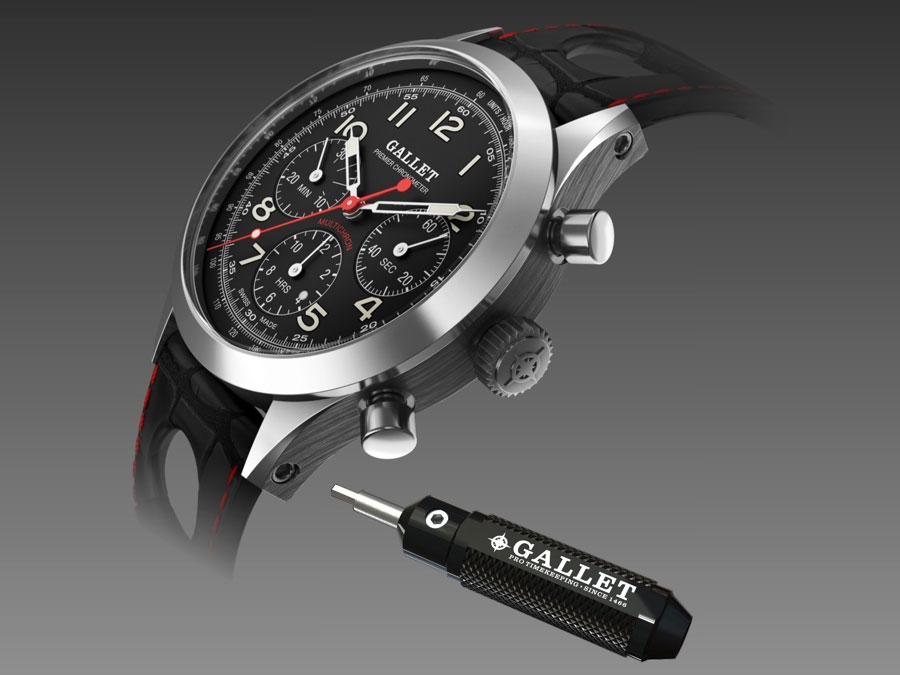
Gallet introduces the first water resistant cases for protecting the delicate mechanism of chronograph wristwatches from the damaging effects of humidity. This new innovation become standard on many models in Gallet's "MultiChron" line of professional use timepieces, as well as the upcoming Flight Officer military issue pilot's watch.

1938

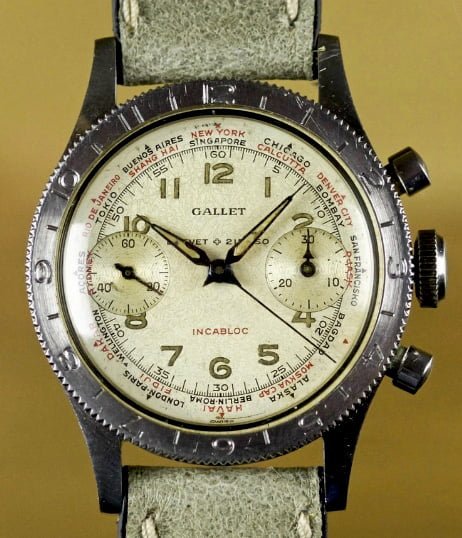
Commissioned by Senator Harry S Truman staff for the pilots of the U.S. Army Air Forces, Gallet creates the Flight Officer chronograph. This wristwatch provides a combination of new innovations. Besides the ability to accurately record events ranging from 1/5th second to 30 minutes in duration, the rotating 12-hour bezel and dial (face) printed with the major cities gives pilots the ability to calculate changes in the time as lines of longitude are crossed. Truman wears a Gallet Flying Officer during his two terms as US president.

1939

Gallet produces the Multichron Petite. The Petite is one of the first wrist chronographs engineered exclusively for enlisted women assigned to technical and scientific tasks during WWII. Powered by the 10 ligne Valjoux 69 movement, and measuring only 26.6mm in diameter, the MultiChron Petite becomes the smallest mechanical chronograph manufactured to date.

1946

With the end of World War II, and the death of his father Georges, Léon Gallet assumes management of the Gallet Company. Only minor changes are needed to transform the appearance of Gallet's military style watches into trendy chronographs for sportsmen and civilian pilots.

1965

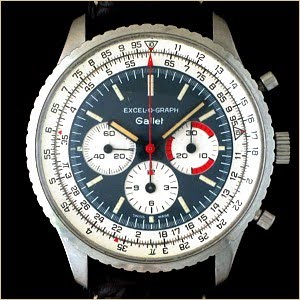
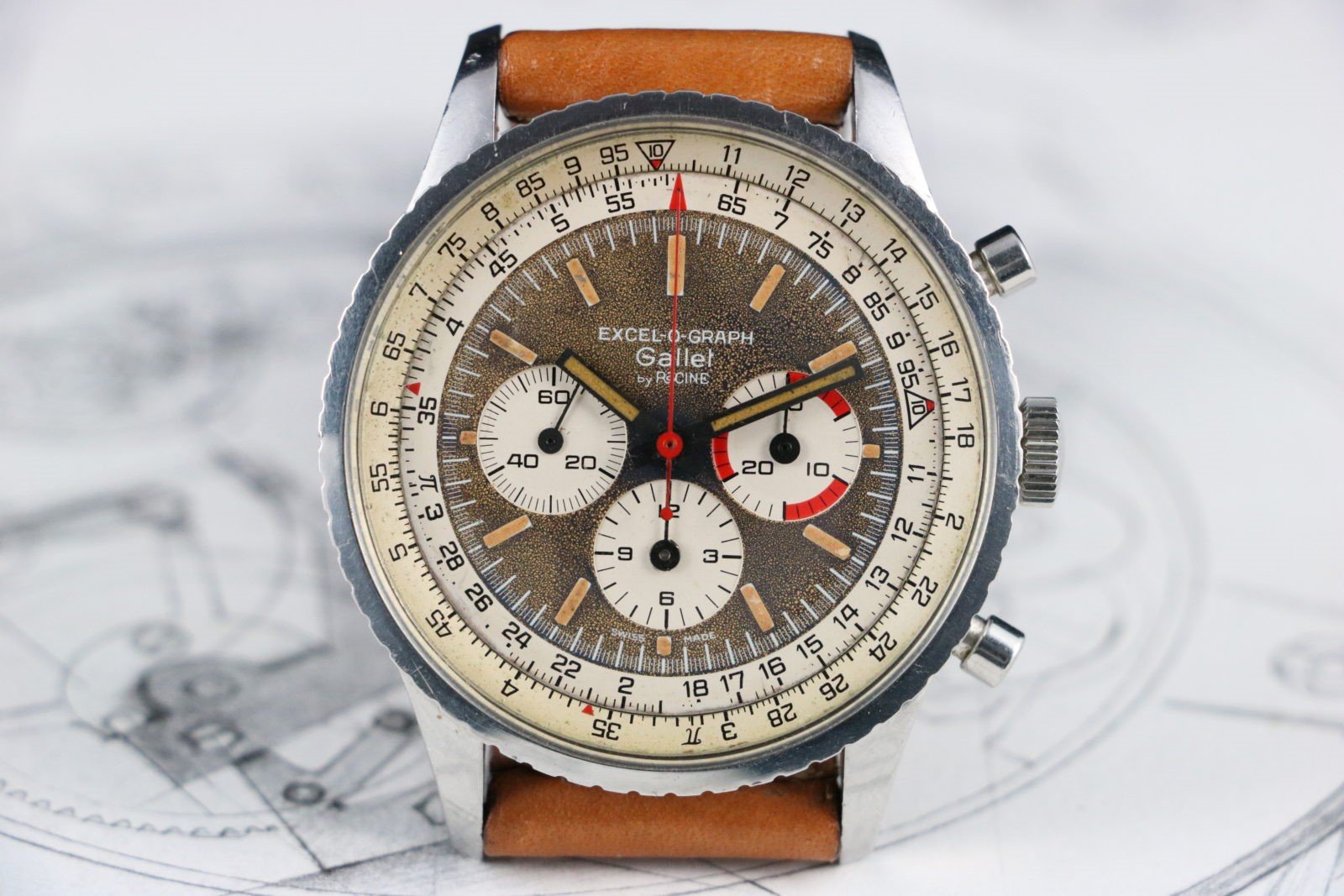
Gallet introduces the Excel-O-Graph. This pilot’s wristwatch features a rotating bezel with integrated slide rule for making navigational calculations during flight.

1970

Asian manufacturers begin releasing electronic quartz regulated timepieces onto the world markets. By continuing to build mechanical timepieces for a clientele not influenced by changing fads and convention, Gallet survives the so called "quartz crisis".

1975

Upon the death of Léon Gallet, sons Pierre and Bernard assume management of the company. They acquire the Racine Company, which has been struggling as a result of devaluation of the U.S. dollar.

1983

Excelsior Park closes its factory on 6 April due to the lack of family successors and a sizable decrease in orders of mechanical movements from its Gallet partner during the difficult "quartz crisis". To continue to support owners of Excelsior Park powered watches, Gallet acquires the balance of the company’s remaining inventory and assets. An attempt in 1984 by the Flume Company of Germany to revitalize Excelsior Park name proves unsuccessful.

1984

Wein Brothers, a Canadian distributor of timing instruments, contracts with the Gallet Company to manufacture rugged wristwatches for distribution to the US Government. To facilitate the initial transactions, the watch dials (faces) of these military specification watches are marked Marathon, a previously held Gallet trademark. Wein Brothers continues to distribute military timepieces and related products under the Marathon brand to the present day.

1990

Gallet supplies 30,000 “Navigator” wristwatches to the Marathon Company for distribution to the U.S. military. Prior to Marathon’s fulfillment of the contract, prototypes are arduously tested by the US Government to withstand the most adverse of circumstances. All examples exceed the military's strict requirements for sustaining accuracy and functionality during combat conditions.

1991

Pierre Gallet retires from the company due to ill health. His brother Bernard assumes control of the company, which continues to focus on the manufacture of professional-use timepieces.

1996

To facilitate expansion, Bernard Gallet enters into a partnership with B. Neresheimer Ltd., a company with over a hundred years experience in the manufacture and distribution of fine silver wares and high-end luxury goods.

2002

The Gallet factory is relocated from La Chaux-de-Fonds to Grandson, a canton of Vaud approximately one hour from Geneva. Walter Hediger, a member of the Neresheimer family, takes the reins of Gallet as its CEO.

2004

Company activity becomes concentrated near Zurich. Bernard Gallet remains active with the company until his death in 2006.

2008

Gallet & Co co-sponsors "Time in Office" at the National Watch and Clock Museum, an exhibition of timepieces worn by America’s presidents extending back to the pocket watches of George Washington. One of the featured items in the exhibit is the Gallet Flight Officer chronograph worn by Harry S Truman during his years in office as the 33rd president of the US.

2009

Gallet & Co co-sponsors "Time & Exploration" at the National Watch and Clock Museum, an exhibit highlighting the importance of time and timekeeping in the fields of exploration and navigation.

From Gallet & Co Website.

Please remember that this is an unofficial account of the history of this
company, Should you happen to find any mistakes with our information then
please let us know at
Email
Us
Gallet History watches history


1893


Berthe Courvoisier (1868-1936), daughter of Louis Philippe
Courvoisier and an heir to the family watch company, is wed to Georges Gallet,
son of Léon. Berthe Courvoisier and her brother Émile, together with Georges
Gallet and his sister Henriette, continue to manage the Courvoisier Frères watch
company. Georges Gallet assumes the role as co-director of the company.


1895


Gallet introduces the first wrist-worn watches for mass
consumption by men and women to the American market. These first
“wristwatches” are immediately rejected due to public perception as
being too unusual for women and too feminine for men. All unsold examples are
soon returned to Switzerland for disassembly. In spite of initial resistance to
this groundbreaking innovation, wristwatches are issued during WWI as a more useful
way for soldiers to tell time in combat situations. As a result, this new
concept gains acceptance, and is soon added to the offerings of numerous other
watch companies.


1896


Rail road pocket watches with chronometer grade movements
with patented regulators are created by Gallet under the Interocean brand name
and distributed by Timothy Eaton (T. Eaton Department Store) for railway use.


1896


Gallet wins a silver medal at the Swiss National Exhibition
in Geneva.


1899


Upon his death, Léon Gallet bequeaths a sum of 43,000 Swiss
Francs (today equivalent to approx. 1,000,000 US dollars) to the town of La
Chaux-de-Fonds, of which 25,000 Swiss Francs is used for the construction of
the Musée international d’horlogerie (International Museum of Watch Making). To
assist the museum in building its initial collection of timepieces, Georges
Gallet donates over 100 highly complex and valuable Gallet, Electa, and
Courvoisier watches. Georges Gallet serves as director of the museum for the
next twenty years.


1900


Shortly after Léon Gallet’s death, the company name is
changed back to Gallet & Cie (Gallet & Co.).


1905


Gallet wins a Diploma of Honor at the Liege Exhibition.


1906


The company name “Gallet & Cie, Fabrique
d’horlogerie Electa” is registered to reinforce Gallet’s ownership and
control of the Electa brand. Under the Electa name, Gallet produces its highest
quality timepieces.


1911


Henri Jeanneret-Brehm, a member of the esteemed Jeanneret
family of St. Imier watchmakers, purchases the Magnenat-Lecoultre factory with
financial assistance from the Gallet company.


1912


Gallet creates the first wristwatch for mass distribution to
include a full-sized constant seconds hand originating from the center of the
dial (face). This innovation proved useful for timing tasks that emphasized
seconds over minutes and hours, including the measuring of the human heart
rate. Gallet’s new “sweep second” wristwatches were issued to military nurses
and medics during World War I.


1914


Gallet wins the Grand Prize in the Chronometer category at
the Swiss National Exhibition in Berne.


1915


Gallet supplies hand held and cockpit mounted timers to the
British Air Force during WW I.  Movements are produced in Gallet’s Electa
workshop and marked with the Electa name.


1916


Gallet supplies wrist-worn timers to the British armed
forces during World War I. This early chronograph wristwatch was an obvious
transitional timepiece. While technically refined and reduced in size from a
traditional hand-held timer, it still retains the three-piece case, porcelain
enamel dial, and center button crown of its larger predecessor.


1917


Gallet wins the 1st place award for chronometer accuracy at
the Canton Observatory in Neuchâtel.


1918


Jeanneret-Brehm begins manufacturing under the company name
Excelsior Park. Deriving the name from Jenneret-Brehm’s previously registered
“Excelsior” trademark, the English variation of the French word for “park” is
utilized at the prompting of Gallet to support the collaborative efforts of the
two companies in their marketing focus on the American consumer. The
cooperative relationship of Excelsior Park and Gallet leads to the development
of a number of time recording mechanisms, including the calibre 40. These new
chronograph movements are utilized almost exclusively in Gallet and Excelsior
Park wristwatches, with a small number supplied to the Girard Perregaux and
Zenith companies when production capabilities allowed.


1927


Gallet introduces the “Regulator” and “Duo Dial”
wristwatches for the medical and technical professions. The large-sized lower
subsidiary seconds dial of the rectangular Duo-Dial and the predominant
resetting sweep-second hand of the Regulator simplify the task of calculating a
person’s per-minute heart rate.


1929


While Gallet develops viable markets for its new wristwatch
innovations, the company is able to survive the Great Depression by supplying
professional use “tool watches” to its military and industrial clients.


1935


As World War II becomes imminent, Gallet begins production
of wristwatches, boat clocks with 8-day movements, and military stopwatches for
Great Britain, Canada, and the U.S.A. At the start of World War II, production
again surpasses 100,000 watches annually.


1936


Gallet introduces the first water resistant cases for
protecting the delicate mechanism of chronograph wristwatches from the damaging
effects of humidity. This new innovation become standard on many models in
Gallet’s “MultiChron” line of professional use timepieces, as well as
the upcoming Flight Officer military issue pilot’s watch.


1938


Commissioned by Senator Harry S Truman staff for the pilots
of the U.S. Army Air Forces, Gallet creates the Flight Officer chronograph.
This wristwatch provides a combination of new innovations. Besides the ability
to accurately record events ranging from 1/5th second to 30 minutes in
duration, the rotating 12-hour bezel and dial (face) printed with the major
cities gives pilots the ability to calculate changes in the time as lines of
longitude are crossed. Truman wears a Gallet Flying Officer during his two
terms as US president.


1939


Gallet produces the Multichron Petite. The Petite is one of
the first wrist chronographs engineered exclusively for enlisted women assigned
to technical and scientific tasks during WWII. Powered by the 10 ligne Valjoux
69 movement, and measuring only 26.6mm in diameter, the MultiChron Petite
becomes the smallest mechanical chronograph manufactured to date.


1946


With the end of World War II, and the death of his father
Georges, Léon Gallet assumes management of the Gallet Company. Only minor
changes are needed to transform the appearance of Gallet’s military style
watches into trendy chronographs for sportsmen and civilian pilots.


1965


Gallet introduces the Excel-O-Graph. This pilot’s wristwatch
features a rotating bezel with integrated slide rule for making navigational
calculations during flight.


1970


Asian manufacturers begin releasing electronic quartz
regulated timepieces onto the world markets. By continuing to build mechanical
timepieces for a clientele not influenced by changing fads and convention,
Gallet survives the so called “quartz crisis”.


1975


Upon the death of Léon Gallet, sons Pierre and Bernard
assume management of the company. They acquire the Racine Company, which has
been struggling as a result of devaluation of the U.S. dollar.


1983


Excelsior Park closes its factory on 6 April due to the lack
of family successors and a sizable decrease in orders of mechanical movements
from its Gallet partner during the difficult “quartz crisis”. To
continue to support owners of Excelsior Park powered watches, Gallet acquires
the balance of the company’s remaining inventory and assets. An attempt in 1984
by the Flume Company of Germany to revitalize Excelsior Park name proves
unsuccessful.


1984


Wein Brothers, a Canadian distributor of timing instruments,
contracts with the Gallet Company to manufacture rugged wristwatches for
distribution to the US Government. To facilitate the initial transactions, the
watch dials (faces) of these military specification watches are marked
Marathon, a previously held Gallet trademark. Wein Brothers continues to
distribute military timepieces and related products under the Marathon brand to
the present day.


1990


Gallet supplies 30,000 “Navigator” wristwatches to the
Marathon Company for distribution to the U.S. military. Prior to Marathon’s
fulfillment of the contract, prototypes are arduously tested by the US
Government to withstand the most adverse of circumstances. All examples exceed
the military’s strict requirements for sustaining accuracy and functionality
during combat conditions.


1991


Pierre Gallet retires from the company due to ill health.
His brother Bernard assumes control of the company, which continues to focus on
the manufacture of professional-use timepieces.


1996


To facilitate expansion, Bernard Gallet enters into a
partnership with B. Neresheimer Ltd., a company with over a hundred years
experience in the manufacture and distribution of fine silver wares and
high-end luxury goods.


2002


The Gallet factory is relocated from La Chaux-de-Fonds to
Grandson, a canton of Vaud approximately one hour from Geneva. Walter Hediger,
a member of the Neresheimer family, takes the reins of Gallet as its CEO.


2004


Company activity becomes concentrated near Zurich. Bernard
Gallet remains active with the company until his death in 2006.


2008


Gallet & Co co-sponsors “Time in Office” at
the National Watch and Clock Museum, an exhibition of timepieces worn by
America’s presidents extending back to the pocket watches of George Washington.
One of the featured items in the exhibit is the Gallet Flight Officer
chronograph worn by Harry S Truman during his years in office as the 33rd
president of the US.


2009


Gallet & Co co-sponsors “Time &
Exploration” at the National Watch and Clock Museum, an exhibit
highlighting the importance of time and timekeeping in the fields of
exploration and navigation.


From Gallet & Co Website.


Please remember that this is an unofficial account of the history of this
company, Should you happen to find any mistakes with our information then
please let us know at

Email
Us


Filed Under: Luxury Timepieces Tagged With: luxury pieces, Luxury Timepieces, Old watches, Timepieces., Vintage watches, watches, watches history, World The Most Expensive Watches

Frodsham watches history

February 25, 2023 by aabbady Leave a Comment

Frodsham watches history

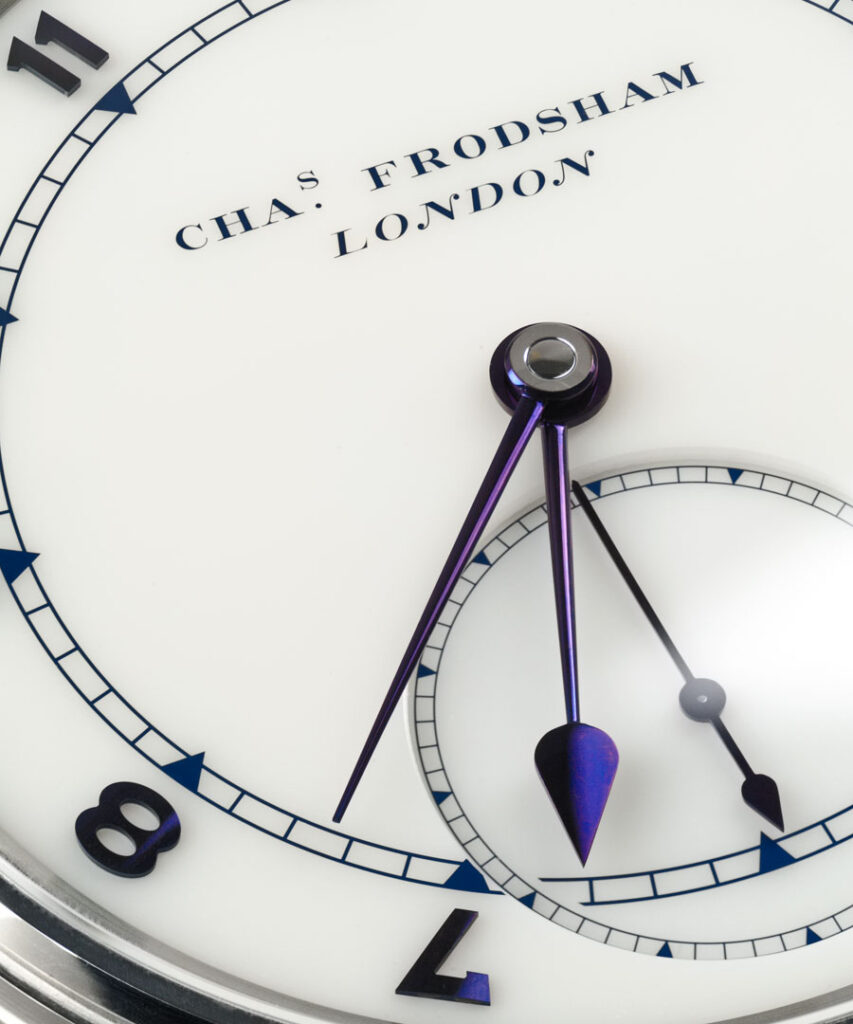
Charles Frodsham & Co is the oldest chronometer manufacturers in the world – 1834

Charles Frodsham  1810 – 1871) was a distinguished English horologist, establishing the firm of Charles Frodsham & Co, which remains in existence as the longest continuously trading firm of chronometer manufacturers in the world.

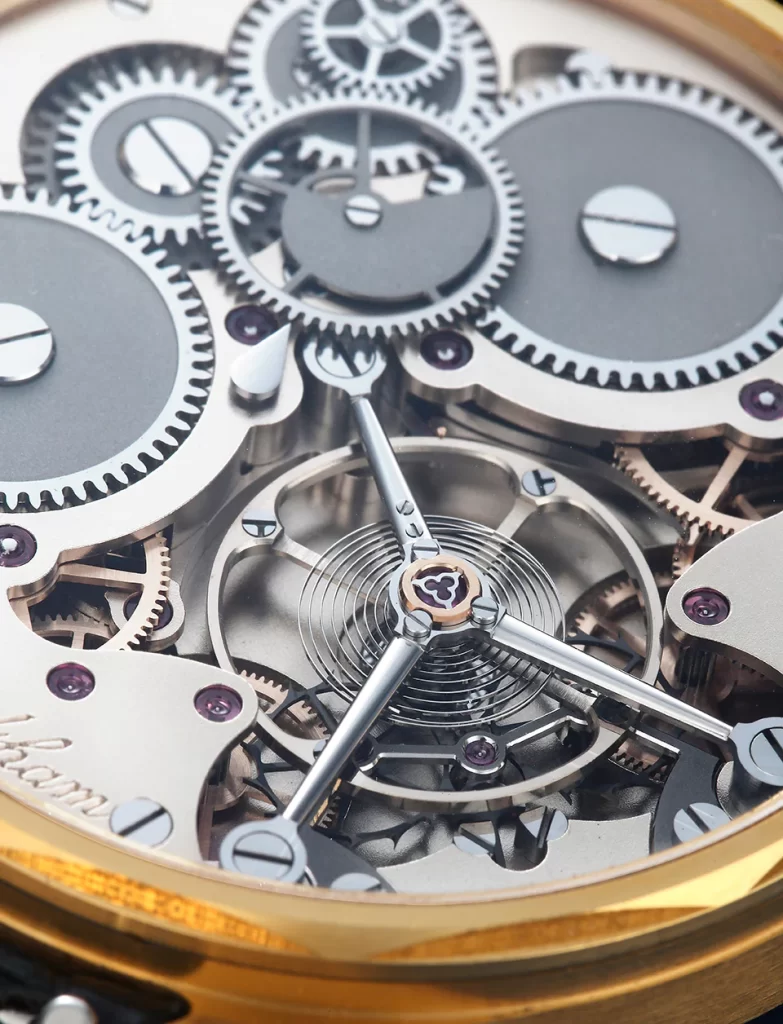
In 2018, the firm launched a new chronometer wristwatch, after sixteen years in development. It is the first watch to use the George Daniels double-impulse escapement.

Frodsham founded his own business at Finsbury Pavement. He rapidly established himself  in London chronometer maker.

With the death of John Roger Arnold, Charles acquired the Arnold business in 1843, moving his family and business address to 84 Strand, London. Trading as ‘Arnold & Frodsham, Chronometer Makers’ continued till 1858.

By the mid-1850s Charles had established himself as one of the period’s most eminent horologists. In 1854 upon the death of Benjamin Lewis Vulliamy, he purchased the goodwill of the business and, upon Airy’s recommendation, succeeded Vulliamy as Superintendent and Keeper of Her Majesty’s Clocks at Buckingham Palace.

This prestigious title aided the sale of clocks, watches and chronometers worldwide, Charles having overseas representation and agents in America, France and Spain. Charles was a liberal supporter and judicial advisor to the societies connected with horology, being one of the founding members, and later Vice President, of the British Horological Institute in 1858, and a Liveryman of the Worshipful Company of Clockmakers, in which he served as Master in 1855 and 1862.

From 1884 the firm traded as Charles Frodsham & Co., becoming incorporated in 1893 and moving to new retail premises at 115 New Bond Street in 1895. With the rapidly emerging car industry in the first years of the 20th century, a new branch specializing in motor accessories was opened in nearby Dering Street in 1911, to sell speedometers and car clocks. These were supplied by Robert Benson North, later a director of Frodshams, from his Watford factory.

The main business moved again in 1914 to premises at 27 South Molton Street, London, where it remained until considerable damage caused by an air-raid in 1941, forced a move to the trading premises of Philip Clowes at 62 Beauchamp Place. Clowes had been in partnership with another horologist, Captain John Henry Jauncey, (Clowes and Jauncey 1932-39), who specialized in antiquarian horology and secured some of the important chronometers for the collections in the National Maritime Museum.

From the late 1940s through to the 1980s, the firm concentrated on the production of mantel and carriage clocks, producing amongst other things the ‘Princess’ clock, presented in 1947 to HRH Princess Elizabeth on the occasion of her marriage. In 1997 the Company moved to 32 Bury Street, where it continues today, specialising in English precision horology.

Please remember that this is an unofficial account of the history of this
company, Should you happen to find any mistakes with our information then
please let us know at

Email
Us

Filed Under: Luxury Timepieces Tagged With: Frodsham watches history, luxury pieces, Luxury Timepieces, Old watches, Timepieces., Vintage watches, watches, watches history

The History of Fossil Watches – fashion watches

February 24, 2023 by aabbady Leave a Comment

Founder Tom Kartsotis created the company to import fashion watches from China to retail in the US. Having founded the brand to import watches, along with his brother, he had soon begun importing leather goods too.

The company’s growth was rapid and in quick succession they acquired Zodiac watches, high-end Swiss brand Michele Watch and retail chain Watch Station. They’d later add Danish brand Skagen at a cost of $225M, a wearable technology company, for $260M.

It is a young brand founded in the mid-1980s. The Fossil Group owns a handful of other brands with Zodiac Watches probably being of most interest to watch fans.

 As a watch manufacturer, they produce watches for a selection of household names including, Burberry, DKNY, Emporio Armani, Michael Kors and Adidas. Although positioned as a fashion watch brand they do have design studios in Biel, Switzerland and manufacturing facilities in China.

Fossil stood out as being the only fashion brand  This, along with the ownership of the Swiss Zodiac Watches, has allowed them to produce Swiss-made ‘Fossil Swiss’ watches.

1984

Founded in 1984, Fossil represented the second entrepreneurial effort launched by Tom Kartsotis, a Texas A&M dropout living in Dallas.

TimeLine

1985

The Company introduces the first Fossil® brand watches.

1986

the Kartsotis brothers launched Fossil watches on the American market.

1987

Fossil, Inc., as the company was now called, was collecting $2 million in sales a year after having established a solid reputation among Texas retailers.

1988

Kosta Kartsotis joined the company in 1988, midway through the most prolific period of growth in Fossil’s short history.

1989

Fossil introduces its iconic “tin box” packaging with designs inspired by graphics from the American fifties. • The packaging is a hit with consumers and Fossil begins packaging all of its watches in tin boxes.

In 1989, the company generated $20 million in sales, having increased its revenue volume tenfold in two years, and made one important change in its marketing approach that spurred further growth in the years ahead.

1990

Fossil participates in their first Basel World watch and jewelry tradeshow in Basel, Switzerland.

they introduced leather goods under the Fossil brand, and the Relic line of watches.

1991

Macy’s opened a 300-square-foot Fossil Watch “Super Shop” in one of the most ideal locations for a small, but fast-growing company to attract attention.

1992

In order to master the acquisition of finished watches, Fossil took over a company in Hong Kong in 1992 and renamed it Fossil (East). It was responsible for supplying watches to the headquarters in America.

They also launched Skagen Denmark, a watchmaking brand.

1993

Fossil completed its initial public offering of stock, selling 20 percent of the company to investors, with Tom Kartsotis retaining 40.5 percent control over the company and his brother Kosta retaining 18.8 percent ownership.

Fossil, Inc. goes public on the NASDAQ exchange as FOSL. • Fossil launches a line of men’s small leather goods including key chains, personal organizers and wallets.

Fossil B.V. was formed in 1993 as a holding company for these three European subsidiaries, with Texas-based Fossil, Inc. controlling 70 percent of its newly formed European holding company.

They opened its capital in 1993 and adopted a strategy based on three main axes – supply control, banching out into fashion brands and distribution verticalization.

1994

The company achieved strides in each direction through three noteworthy developments.

1995

The extensive line of Fossil fashion watches were sold in department stores and in other upscale retail settings in more than 50 countries, giving the company a broad geographic foundation to support its business.

Single-brand Fossil stores were launched in 1995.

1996

Toward this end, the company acquired 81 percent of the Seiko-owned Fostim in April 1996, paying $700,000 in cash to gain greater control over the distribution of Fossil products in Japan.

1998

Fossil develops Big Tic® – a part analog, part digital watch that quickly becomes one of the company’s signature designs.

1999

Fossil, Inc. signs a worldwide licensing agreement to produce and distribute watches for DIESEL and DKNY. • Fossil launches a line of optical frames through an agreement with Safilo, one of the world’s leading eyewear manufacturers.

The company’s growth has relied on the development of online sales, the creation of a network of shops, and the acquisition of distributors.

2000

Fossil launches an extensive collection of clothing and denim sold exclusively in FOSSIL clothing stores and on fossil.com. • Fossil opens stores in UK, Germany and Singapore. • Fossil introduces jewelry in Germany.

2001

Fossil acquired Zodiac and invested in various companies that produced components and assembled watches.

2004

Fossil, Inc. acquires MICHELE watches. • Michael Kors announces a partnership with Fossil, Inc. for men and women’s timepieces. • Fossil, Inc. announces a partnership with Marc Jacobs for men and women’s timepieces. • Fossil, Inc. enters a worldwide watch licensing agreement with ADIDAS.

Purchase of Michele Watch completed the cycle by offering a high-end Swiss watch with a designer flair.

2006

Fossil publishes “Tinspiration,” a retrospective design book showcasing popular tin designs from years past. • Fossil opens its first retail store in Austria.

Fossil launched a Swiss Made collection for Georgio Armani that was exclusively sold in the shops of the Italian designer.

2007

In September, Fossil was accused of infringing a patent owned by Financial Innovations Systems, LLC, in a lawsuit filed in the Northern District of Texas.

The Watch Station International chain was purchased from Luxottica/Sunglass Hut in December 2007.

Fossil launches jewelry in the United States • Fossil launches first e-commerce site outside the United States in Germany.

2009

Fossil celebrates its 25th Anniversary with the re-issue of its most iconic watches.

2010

Fossil opens its first clothing stores outside the United States in Germany and U.K.

2012

Fossil, Inc. agreed to purchase Skagen Designs and some of its partners for approximately $225 million in cash and 150,000 Fossil shares.

2013

Fossil introduced their upscale and more expensive “Fossil Swiss” line of watches which are made in Switzerland.

2015

Fossil acquired Misfit for $260 million, with plans to incorporate Misfit’s technology into traditional-looking watches.

Please remember that this is an unofficial account of the history of this
company, Should you happen to find any mistakes with our information then
please let us know at

Email
Us

Filed Under: Luxury Timepieces Tagged With: luxury pieces, Luxury Timepieces, Old watches, Timepieces., Vintage watches, watches, watches history

Frederique Constant watches – 1881 – relaunched their first collection in 1992

February 24, 2023 by aabbady Leave a Comment

Frederique: Frederique Schreiner 1881-1969

Constant: Constant Stas 1880-1967

The current Managing Director of Frederique Constant S.A., Peter Stas, is a 4th generation descendant of Mr. Constant Stas, who founded his company in 1904, making printed clock dials for the watch industry.

Frederique Constant was established in 1988. Aletta Bax and Peter Stas launched their first collection in 1992, comprising six models fitted with Swiss movements and assembled by a watchmaker in Geneva.

Frederique Constant is involved in all the stages of watch production, from initial design to final assembly. Watches manufactured under its trademark are either designed by Frederique Constant or by independent designers contracted for a specific series of models. Strong emphasis is placed on watch design to keep abreast of trends and customer preferences. Frédérique Constant uses cutting-edge computer software, principally computer aided design software, to assist in the watch design and development process.

Frederique Constant has exhibited at the World Watch, Clock and Jewelry Show in Basel since 1995. As the company flourished, Aletta Bax and Peter Stas decided to move to Geneva themselves, to develop the brand in the heart of the watchmaking capital.

The new Frederique Constant manufacture is 3200 square meters, divided over four floors, offering an attractive working environment in the sectors of movement component production, caliber assembly, watch assembly, and extensive quality control. Numerically-controlled machines of the latest generation are located in a large atelier in the basement, where all component manufacturing is concentrated. Caliber, watch assembly, and state-of-the-art quality control are primarily organized on the first floor of the new Frederique Constant building. The building is also the brand’s international headquarters.

https://us.frederiqueconstant.com/

Please remember that this is an unofficial account of the history of this
company, Should you happen to find any mistakes with our information then
please let us know at

Email
Us

Filed Under: Luxury Timepieces Tagged With: luxury pieces, Luxury Timepieces, Old watches, Timepieces., Vintage watches, watches, watches history

FORTIS Watches AG was founded by Walter Vogt in 1912

February 24, 2023 by aabbady Leave a Comment

FORTIS Watches AG

1912

The Swiss village of Grenchen was and still is the residence of FORTIS when the company was founded by Walter Vogt in 1912.

Mr. Vogt was a great pacesetter and pioneer: his original beliefs still forms the basis of today’s company’s policy. “..the manufacture of high-quality quality Swiss watches, in innovative designs at inexpensive prices..”

1924

The most significant year in the history of FORTIS was in 1924, when Walter Vogt met John Harwood, the British inventor of the automatic wristwatch. Harwood had already been looking for two years to find an manufacturing partner to mass produce his invention in Switzerland.

In the founder of FORTIS, he discovered an en-lighted defender of “the automatic wristwatch” concept. Walter Vogt backed the project and provided significant financing so that he could implement this invention into production.

1926

The world’s first self-winding wristwatch in true production was the “Harwood Automatic” and was presented at Basel Switzerland.

1930s,

FORTIS produced two more classic automatic watches which became famous products: First came the “Rolls”, a wristwatch, which was to become legendary with a winding system developed by Leon Hatot of Paris. The watches name was derived from the motion of the movement inside the case to wind the movement.

1931

FORTIS produced the Autorist, which used another automatic mechanism invented by John Harwood. The watch was powered by movements of the strap by means of its attachment to the watch.

1937

On the occasion of the company’s 25th anniversary FORTIS manufactured their first chronographs which are admired for their precision until today. “Wandfluh”, the name of the Jura massive close to Grenchen as name of the FORTIS Chronograph became known throughout the world.

1943

The Latin word meaning of FORTIS is “strong” and with the presentation of the first waterproof watches from Switzerland FORTIS again perfectly meets the market demands with their most successful model “Fortissimo”.

 1950s

Some decades later to its first appearance on the market the alarm wrist watch enjoys renewed popularity thanks to the efforts of FORTIS.

1954

FORTIS takes up the manufacturing of the alarm watch, thus becoming closely associated with the worldwide distribution of the most serviceable timepiece ever marketed.

1956

FORTIS wins the leading chronometer awards conferred by the Swiss Institute for Official Watch Timekeeping Tests, awarded to their waterproof alarm watches of the “Manager”-series. Every single “FORTIS-Manager” alarm watch tested, obtained the supreme distinction “especially good results”.

Timepieces of the Late 1950s to Early 1980s

1957

In Tokyo 600 watchmakers celebrated the so-called “FORTIS day” in Yamaha hall on the 26 th of November. The company invited the Japanese watchmakers to promote the new electrical regulation system “BEP” presented by FORTIS and as thus the good relationship with the members of the Japanese watchmakers society.

1962

The name of FORTIS- synonymous worldwide for reliable automatic watches from Switzerland- continues with their jubilee watch on the occasion of the company’s 50th anniversary “Stratoliner” and the “Spacematic”, a 25 atmospheres tested absolutely wateresistant anchor watch, high precision automatic, with date indication and chosen by the members of the American astronauts team that year.

1965

With the upcoming quartz watches from Japan FORTIS like all the other Swiss brands had to face a competition on the market, which a lot of them could not stand.

The FORTIS answer on this challenge, based on the companies experiences in water resistant diver watches was the development of the “Flipper” watch. For the American market: the “FORTIS-Cobra”, a most striking design which was a real hit and enormous success in those swinging times.

1975

FORTIS set the pace in watch fashion with the “Flipper quartz leader” model, a great success in more than 40 countries the following years. This watch range incorporated the original FORTIS Container System, allowing the movement and bracelet to be interchanged within seconds.

1982

The “Flipper quartz leader” provides besides steel and 18 ct. gold bracelets a wide range of colorful straps and thus made this FORTIS design a hit in the early 80s, worn for example by The Rolling Stones, Roman Polanski, Leonard Bernstein, etc.. The “…aristocrat of the plastic watches”..V. Philbert, Europa Star.

1987

On the occasion of the company’s 75th anniversary FORTIS sets a trend by relaunching the automatic wristwatches which had been synonymous for the brand in the glory past. Besides the Original FORTIS Container System with the successful range of the “FORTIS Logo Swiss” collection and the Harwood being the world’s first automatic wristwatch in series production, FORTIS relaunched the legendary pilot’s watches with their clear functions and easy to read dials in the typical FORTIS design that year and marks the renaissance of mechanical watches, a trend which a lot of Swiss watch companies followed until today.

1992

FORTIS steps into space on board of the first advertising and art painted space craft, a Russian proton rocket. One dial of a limited series of the FORTIS Stratoliner automatic chronograph participates in the first “space museum” in orbit. Since then a close cooperation between FORTIS and several Russian space institutions lead to the development of the FORTIS OFFICIAL COSMONAUTS CHRONOGRAPH, which was tested on the border of modern physics and under spaceflight simulation and proved its reliability on the wrist of the Russian cosmonauts even in open space.

1994

After two years of testing and preparation the Yuri Gagarin Russian State Scientific-Research Test Center of Cosmonauts Training in Star City chose the FORTIS OFFICIAL COSMONAUTS CHRONOGRAPH to be part of their cosmonauts official equipment. Developed in intensive cooperation with the experienced experts of the center the FORTIS automatic chronograph received its unique design which meats the cosmonauts needs in every detail of its function.

The space mission EUROMIR I crew was the first to which the FORTIS Official Cosmonauts Chronograph Sets were presented to in October. Since then the FORTIS Sets were presented to all Russian cosmonauts of the Gagarin Center and the FORTIS Chronographs proved their reliability on the wrists of astronauts and cosmonauts in their professional activity and during several extra vehicular activities in open space.

1995

Deeply involved in the world of aviation the FORTIS Chronographs were the timekeeping instruments of the world height record on a MIG 25PU double seated -non experimental- aircraft with a civil passenger, honored by the Guinness book of records.

 1996

After a successful launch of the FORTIS Cosmonauts and Pilot’s collection in Europe FORTIS started its market approach with a spectacular debut in Asia.

1997

The FORTIS OFFICIAL COSMONAUTS CHRONOGRAPH was chosen to be the official watch of the Russian-German space mission MIR 97. On the occasion of the company’s 85th anniversary the world’s first automatic chronograph with mechanical alarm was presented at the Basel fair. In close cooperation and as per the demands of the cosmonauts developed, FORTIS exposed this mechanical specialty in a limited anniversary edition of 100 pieces in platinum, to be followed by a steel version later.

1998

The Hungarian Air Force uses the FORTIS Pilot Professional Chronograph Automatic to equip their pilots.as well as several other countries.

2009

The Fortis brand name is still used by BNP Paribas in Belgium, but its colorful logo was discontinued in 2009 shortly after the acquisition.

From Fortis website.

Please remember that this is an unofficial account of the history of this
company, Should you happen to find any mistakes with our information then
please let us know at

Email
Us

Filed Under: Luxury Timepieces Tagged With: Ancre, FORTIS Watches AG, luxury pieces, Luxury Timepieces, Old watches, Timepieces., Vintage watches, watches, watches history, World The Most Expensive Watches

Festina watches history

February 24, 2023 by aabbady Leave a Comment

Festina, a Swiss watch manufacturer, was established in the
year 1902. It is the certified timekeeper of the Tour de France. Being over 100
years old, it comes among the leading names in Europe and also a a best seller
in its home country of Spain. At the moment, the Festina brand carries on its
heritage of fashionable European watches with a widespread compilation of
stylish, handy and sporty watches for almost every occasion.

From the period of its establishment, Festina watches have
carved out a niche brand by way of an inimitable persona. Shaped in the midst
of the altering generations, these watches are elegant, vibrant as well as
highly efficient. These are genuinely meant for people who breathe their lives
strongly and love to cherish every single moment through the thick and thin of
life.

These watches are composed of Japanese quartz movements and
other matchless, inherent features. The Mecaquartz movement, a no-battery
mechanical quartz movement, is another distinguishing feature of the brand. In
addition to all these exceptional attributes, a major chunk of Festina’s
watches take account of sports chronographs comprising the globally advertised
Road Warrior string of chronographs.

Festina also hogged media limelight in the year 1998 through
a dubious reason. The team sponsored by the Festina in the Tour de France, was
trapped in a doping scandal.

Festina offers a broad product range – digital, analog,
chronograph, leather, stainless steel and titanium. It truly doesn’t matter,
whichever model you pick, it will have a long, lasting effect on your
personality. Some particular models have pitched Festina on the top of the
market and almost turned it into a monopolistic brand in the watch market. Some
models are extremely adored by sports enthusiasts and from time to time, the
company has come up with innovative features to give them further boost.

The Tour De France alarm watches, when rolled in the market,
fuelled the competition and forced other watch producer to match its level. The
brand got some rave acclaim from the competitors as well. Its status received a
further boost when it launched the modified version of the brand by presenting
it as Festina Tour de France Alarm Chronograph watch.

For the past 15-20 years, Festina watches have created a
sort of segment for itself by touching the pulse of the watch lovers. Now, it
mainly focuses on the sports range due to the growing popularity of the
sporting events. It has a strong team in the form of technical support which is
primarily focused on the process of innovation. Sponsoring of some professional
cycling events has given it a worldwide reach as well as recognition.

In the terms of marketing strategy, Festina has surpassed
even some leading watch makers and still holds a reputable place. For every
country, it has adopted a different set of strategies. Its association with
cycling events has created a vast market for it even outside Europe. US being a
large market, the company adopted an entirely different strategy for the U.S.
It allowed some U.S. distributors to make merry by selling the watches through
the bike shops. It provided some discount as well to boost the process and is
now reaping the rewards in the form of growing demand of Festina in the US.

Please remember that this is an unofficial account of the history of this
company, Should you happen to find any mistakes with our information then
please let us know at

Email
Us

Filed Under: Luxury Timepieces Tagged With: a Swiss watch manufacturer, Festina, luxury pieces, Old watches, Timepieces., Vintage watches, watches, whichever model you pick

Eterna the Swiss luxury watch company

February 23, 2023 by aabbady Leave a Comment

Eterna is a Swiss luxury watch company founded in Grenchen, Canton Solothurn, on 7 November 1856 by Josef Girard and Urs Schild.[1] The company is now owned by Hong Kong-based Citychamp Watch & Jewellery Group Limited, an investment holding company formerly known as China Haidian Holdings-

The name Eterna is synonymous with timepieces of the highest quality, with Swiss watchmaking Tradition, and with an outstanding Spirit of innovation. The passionate desire to master horological challenges as well as to constantly improve existing Features has been driving Eterna since 1856.

It is therefore no surprise that the Workshops in Grenchen have time and time again enriched and revolutionized the art of watchmaking.

Today, Eterna is still characterised by this ingenious creativity. The current collections reflect the brand’s respect for tradition, alongside Eterna’s commitment to pioneering new designs and movement technologies.

Milestones in Eterna’s history

Eterna has since 1856 manufactured high-quality mechanical timepieces born of traditional craftsmanship. Over its more than 150 years of existence, numerous major developments have emerged from the company’s workshops.

In 1937

A newly married Thor Heyerdahl decided to extend his honeymoon on the Marquesas Islands, ideally located in the middle of the Pacific Ocean. The geography and zoology he had studied at the University of Oslo gradually led the young Norwegian to formulate a daring hypothesis. He came to suspect that the prevailing winds and maritime currents could have made possible the human colonisation of Polynesia by people from South America rather than from the continent of Asia. Furthermore, the name of an Inca sun-god, Kon-Tiki, seemed to appear in Polynesian religious myths.

Ten years later, Thor Heyerdahl found himself in Callao, on Peru’s Pacific coast, overseeing the construction of a balsawood raft similar to those known to have existed before the Spanish conquest. The budding explorer named it Kon-Tiki in salute to the Inca sun-god.

After rounding up sufficient financial backing, he and five other Scandinavians with varying scientific interests sailed from Callao on April 28 1947, with minimal supplies and a radio set. The six men relied on Pacific winds and currents to propel them all the way to Polynesia.

Strapped to his wrist, each Kon-Tiki crew member carried an Eterna timepiece, the contribution of one of the few watch manufacturers of the day to have truly mastered watchcase watertightness.

After 101 adventurous days and nights, covering some 8,000 kilometres (4,320 nautical or 4,971 land miles), the voyage ended somewhat abruptly on the coral reefs of the Raroia atoll in the Tuamotu archipelago. The crew was fine, the raft a bit the worse for wear. The Eterna watches, for their part, were running as smoothly as ever, unaffected by water, moisture, salt corrosion and temperature variations. Back in Granges, Switzerland, Eterna’s technical teams drew the appropriate conclusions.

From a legendary figure and name, Kon-Tiki would now become an exceptional horological dynasty.

1948

Since 1948, Eterna’s added value to time

From 1948 on, Swiss-made self-winding movements benefited from a major technical advance devised and implemented by Eterna: ball-bearing assisted rotational movement. Swiss wristwatches fitted with this revolutionary innovation soon enjoyed worldwide success, solidly consolidating Eterna’s reputation internationally. Today’s revival of the “1948” in a dimensionally updated version and a choice of two dial styles preserves the technical inventiveness and overall excellence of the original. A contemporary classic in its own right, its shapely contours and typically incurved case lugs are back essentially unchanged

1948 – the year of a pivotal invention

Eterna’s epochal 1948 development proved a major step forward for self-winding technology, with a ball-bearing greatly easing the oscillating weight or winding rotor’s rotation around the pivot axis. Reducing wear and tear on vital parts, Eterna’s development extended the watch’s working time, hence its useful life – a smart way to increase its value.

Eterna knew it had a winner and made the most of it. Management lost no time turning the five spheres of the now-famous bearing into its now-celebrated corporate symbol.

The “1948”, acclaimed the world over

In a matter of months, the watch’s reputation, quickly followed by the watch itself, established itself all over the world. Runaway sales of the model delighted then surprised Eterna, the company finding itself with a worldwide best-seller. For years to come, the “1948” would find discerning   customers everywhere. Its popularity set new records.

Please remember that this is an unofficial account of the history of this company, Should you happen to find any mistakes with our information then please let us know at

Email Us

Filed Under: Luxury Timepieces Tagged With: luxury pieces, Luxury Timepieces, Old watches, Timepieces., Vintage watches, watches, watches history

ETA SA – ETA SA Manufacture Horlogère Suisse develops and produces quartz

February 23, 2023 by aabbady Leave a Comment

ETA SA Manufacture Horlogère Suisse develops and produces quartz, mechanical and Swatch watch movements. The company’s headquarters are in Grenchen (Solothurn). ETA Manufacture Horlogère Suisse is the motorist of time at the heart of the Swatch Group www.swatchgroup.com

Before becoming a single undertaking in 1985, the ETA SA brand consisted of a number of ébauche factories across the whole of the Swiss Jura arc grouped together under the name Ebauches SA. This plurality allowed Ebauches SA to offer a wide range of products, as each affiliated company specialized in a particular niche (simple watches for men, chronographs, small watches for women etc.).

The group’s first ébauche workshop and business was opened in Fontainemelon (Neuchâtel) in 1793 by four master watchmakers. This date marks the founding of what is now ETA SA Manufacture Horlogère Suisse, who would continue to act as a motorist of time over the next four centuries thanks to the expertise of its employees and their mastery of watchmaking techniques.

FIRST PROTOTYPES

1967

The Centre Electronique Horloger (Neuchâtel) presents the first prototypes of Swiss quartz watches. Ebauches SA is the largest CEH shareholder, holding 39.5% of the capital. The Beta 21 calibre (industrial version) is presented at the 1970 Basel Watch Fair.

Legend: Prototypes Bêta 1 et 2, Centre Electronique Horloger

CALIBRE 9181

THREE-HAND QUARTZ

1972

The 9181 calibre is the first three-hand quartz movement developed by Ebauches SA in collaboration with Ebauches Electroniques Marin.

Legend: Calibre 9181, Ebauches SA

CALIBRE 940.111

PARTICULARLY FLAT DIMENSIONS

1976

This three-hand quartz calibre is characterised by particularly flat dimensions. The total height of the movement is just 3.7 mm. 

Legend: Calibre 940.111, Ebauches SA & Ebauches-Fabrik ETA

CALIBRE 900.231

SECOND TIME ZONE AND DIGITAL CHRONOGRAPH

1978

This calibre is characterised by an analogue-digital display. The LCD model enables chronograph functions (minute and seconds) and second time zone functions to be displayed.

Legend: Calibre 900.231, Ebauches SA

CALIBRE 999.001

CASE SERVING AS THE MAIN PLATE

1979

The case of the Delirium serves as the main plate. The height allowed for components is just 1.98 mm in this first model. In 1980 this will be reduced to a thickness of 0.98 mm.

Legend: Calibre 999.001, Ebauches SA & Ebauches-Fabrik ETA

CALIBRE 500 SWATCH GENT

INTEGRATED INHIBITION CIRCUIT

1983

The industrialisation of production methods and the automation of assembly processes allow pieces to be manufactured in large volumes.

The operation of Swatch watches is controlled by an integrated inhibition circuit.

Legend: Calibre 500, Ebauches-Fabrik ETA

CALIBRE 958.331

CONTROL VIA ELECTRONIC SHAFT

1984

This multifunction calibre is equipped with a bi-directional motor and an analogue-digital display (LCD). An electronic shaft controls the alarm, timer and chronograph.

Legend: Calibre 958.331, Ebauches-Fabrik ETA

CALIBRE 255.511

TEMPERATURE COMPENSATION VIA SECOND QUARTZ

1985

First temperature compensation system made by ETA. Integration of a second quartz thermometer oscillating at a frequency of 262 kHz, achieving an accuracy level of +/- 10 seconds per year. The adjusted operation is stored in a non-volatile memory.

Legend: Calibre 255.511, ETA SA

CALIBRE 255.241

INCLUSION OF TWO MOTORS

1986

This calibre is characterised by the overlaying of two motors: one for the movement, the other for the chronograph function which can be read in analogue way.

Legend: Calibre 255.241, ETA SA

CALIBRE 255.485

MOON PHASE

1987

The 255.48x calibre is available in four different versions. All include the Moon phase function at the 6 o’clock mark, only the position of the day and month discs differs.

Legend: Calibre 255.485, ETA SA

CALIBRE 251.262

CLASSIC CHRONOGRAPH APPEARANCE

1988

The chronograph function can be read in analogue way thanks to the three counters at 2 o’clock, 6 o’clock and 10 o’clock. This layout gives the model a classic appearance.

Legend: Calibre 251.262, ETA SA

CALIBRE 252.411

PERPETUAL CALENDAR

1990

This calibre has a perpetual calendar window programmed until 2099.

Legend: Calibre 252.411, ETA SA

CALIBRE 255.513

NEW TEMPERATURE COMPENSATION

1994

ETA develops another temperature compensation system. Unlike the 1985 technology, the temperature is no longer measured using a second quartz but instead directly within the integrated inhibition circuit.

Legend: Calibre 255.513, ETA SA

CALIBRE 251.274

https://www.eta.ch/en/enterprise/history

Please remember that this is an unofficial account of the history of this company, Should you happen to find any mistakes with our information then please let us know at

Email Us

Filed Under: Luxury Timepieces Tagged With: luxury pieces, Luxury Timepieces, Old watches, Timepieces., Vintage watches, watches, watches history

CITIZEN is a manufacture, a watch company that does all its manufacturing in-house

February 23, 2023 by aabbady Leave a Comment

Citizen Watch was originally founded as Shokosha Watch Research Institute in 1918 and is currently known as the manufacturer of CINCOM precision lathe machine tools as well as CITIZEN watches.

The trade name originated from a pocket watch CITIZEN sold in 1924. It is one of the world’s largest producers of watches.

Today Citizen Watches continues to develop some of the most advanced watch technology with its Eco-drive range. Citizen Eco Drive has created an ecologically friendly collection of light powered watches. These watches run continuously on any kind of light for a lifetime of use without batteries. With an extensive range of styles and features, Citizen watches provide exceptional technology and quality.

If the Swiss are leaders in mechanical technology, Citizen is the innovator in quartz technology, primarily with their Eco-Drive, which offers unstoppable power for some of the finest designs in Japanese watchmaking. Citizen manufactures every part of their quartz watches, and their watch empire manufactures one out of every four watches the world purchases every year. Not bad for a company named with the hope that every.

citizen would someday benefit from and enjoy their own luxury watch.

All Citizen watches carried by World Lux are powered by Eco-Drive. Citizen’s Eco-Drive technology harnesses power from any natural or artificial light source and converts it into energy which is stored in the Eco-Drive energy cell. Your citizen6watch recharges continuously to run forever (for a power reserve up to 5 years on most models), so you’ll never need a replacement battery!

Eco-Drive

In the United States, Citizen is best known for its Eco-Drive range of watches. All Eco-Drive watches are powered by a solar panel hidden under the face of the watch, which is supplemented by an automatic quartz power source in the rare and discontinued Eco-Drive Duo series. All Citizen Eco-Drive models are made in Japan.
Additionally, Citizen manufactures a watch bearing the colors and logo of the Blue Angels. The watch is part of the Skyhawk line, which utilizes Eco-Drive as its primary power source. Just as the Blue Angels use blue and gold as their trademark colors, the watch bears this color scheme as well.

For almost eight decades, Citizen has been ahead of its time. Our brand has always stood for innovations and high precision that make life better for everyday people and now we are raising our sights to meet the needs of the new Millennium

The beginnings go back to 1924, when Citizen’s forerunner, the Shokosha Watch Research Watch Institute produced itscitizen7 first pocket watch the “CITIZEN”. The then Mayor of Tokyo, Mr Shimpei Goto, named the watch “CITIZEN” with the hope that the watch, a luxury item of those times, would become widely available to ordinary citizens and be sold throughout the world.

Time and again Citizen has pioneered groundbreaking technologies and helped to make watches an indispensable part of modern life. Introduced in 1956, Parashock was the first shock resistant watch made by a Japanese manufacturer. And three years later, Parawater was hailed as the country’s first water resistant watch.
One of the latest milestones is our Eco-Drive system. Bringing new thinking to the art of watchmaking, this is a light powered solution that eliminates the need to change batteries – a revolution that made it the first watch technology to receive the Japan Environment Association’s Eco Mark for environmentally friendly products.
And in 2003, Citizen continues to evolve and be ahead of its time with the launch of Stiletto. This is the World’s thinnest light powered watch – a watch so revolutionary it combines eco-drive technology with a refined, sleek and sophisticated case and bracelet from 4.4mm thick.

Citizen is, however more diverse then simply watches. In fact watches only represent less than 40% of the company’s business. Today we are drawing on a heritage of proven quality and technologies as we develop the market for watches, clocks, jewellery, eyeglass frames and health care products.
The Citizen Watch Company, Ltd. was established in 1930. Citizen Watches Australia (CWA) was established in May citizen 1965 with its head office in Brookvale, NSW. We operate across Australia, New Zealand, South Africa and the South Pacific Islands.

Citizen believes that delivering excellence is the key to building successful partnerships with retailers and consumers alike. Excellence in product, marketing and service is paramount, and the resources required to achieve excellence are viewed as investments, not costs.

Citizen looks forward to the challenges that the future will no doubt bring. Our guarantee is a commitment to continually strive and work towards an even more successful future for our retailers and consumers. Ready for further growth and progress, we are working harder than ever to explore new directions and contribute to changing lifestyles.

Citizen Watch Company first expanded into North America with the founding of the Citizen Watch Company of America in 1975. More people depend on a watch made by Citizen than any other timepiece. As recently as five years ago, Citizen produced about 25% of the total watches produced in the world.

Citizen has thrived with innovation to create the world’s first professional dive watch with an electronic depth sensor, and is a leader in battery-free timekeeping with its Eco-Drive collection of light powered watches. The Eco-Drive maintains an awesome 180-day power reserve so it runs continuously, even in the dark. Citizen Eco-Drive technology harnesses the power of the sun, or any light source, so you never have to change a battery. These light powered quartz watches maintain a power reserve, so they run continuously.

About 300 engineers and scientists, as well as dozens of designers work on the development of new watches at the citizen9Citizen research centres. Citizen has repeatedly set new standards in the watch market.
For example:

1975 the most accurate watch in the world

1976 the first solar watch

1978 with a width of less than 1 mm, the slimmest wrist watch

1980 measuring only 9 x 7 x 2 mm, the smallest movement

1983 the first watch with a thermometer, waterproof up to 100 m

1985 the first diver’s watch with an electronic depth gauge

1987 use of the high-tech material, titanium

1989 the first professional mountaineer’s watch with integrated altimeter and barometer

1990 the first multiple-time-zone radio-controlled watch

1994 the first diving watch with a PC interface

1994/95 introduction of the environmentally-friendly Eco-Drive technology

1996 radio-controlled Eco-Drive watches

1997 Citizen Eco-Drive Signature. Amazing accuracy for a quartz watch of +/- 10 sec. per year

1998 the Citizen Eco-Drive Duo featuring the revolutionary hybrid-movement (Eco-Drive + Automatic) and the first professional diving watches to use

light energy, the Citizen Promaster Aqualand Eco-Drive Chronograph

1999 the innovative Eco-Drive Thermo is powered by the temperature difference between the back of the watch’s case, warmed by body heat, and the surrounding air temperature

2000 the Eco-Drive Vitro features specially developed photocells incorporated almost invisibly into the watch’s glass face, thereby enabling new designs.

Please remember that this is an unofficial account of the history of this.

company, should you happen to find any mistakes with our information then

please let us know at

Email

Us

Filed Under: Luxury Timepieces Tagged With: CITIZEN is a manufacture, luxury pieces, Luxury Timepieces, Old watches, Timepieces., Vintage watches, watches, watches history

Bovet Swiss manufacturer of luxury timepieces

February 22, 2023 by aabbady Leave a Comment

The History of Bovet Watch

Founded by Edouard Bovet (1797–1849)
who learn the watch making in his early life by his father who was a watchmaker
himself. He later in 1814 sent to UK to learn in the school of watch making
then to China in 1818 where he made several sale and like the Market there. In
1922 he started his watch company in London. The majority of his product
shipped to China to be sold there.

The company sold several times until
2001 when The Company was acquired by Pascal Raffy, its current president.

From http://www.bovet.com/maison/history/

1797

Edouard Bovet was born in Fleurier.
He is the son of a master watchmaker Jean-Frederic Bovet. –

1814

Edouard Bovet completeshis
watchmaking apprenticeship and leaves Fleurier with his brothers Alphonse and
Frédéric for London, at the time one of Europe’s leading watchmaking cities but
more importantly a major trading centre for clocks and watches

1818

Edouard Bovet leaves London on April
20th on board of the Orwell, a vessel operated by the East India Company. He
arrives on the 16th of August in Canton where he very quickly sells four
watches for the sum of 10.000 francs, the equivalent of one million dollar in
our day

1822

Edouard Bovet, living in Canton,
creates with his brothers who remained in London, and with his third brother
Gustave, a watchmaker in Fleurier, a general partnership with a view to trading
in watches with China. The first bill of the sale of the Bovet Company written
in London bears the date 1st May 1822. Faith with a rapide growth in business,
the company transfers its manufacturing.

1830

Construction begins on the BOVET
house in Fleurier commonly called “the Chinese Palace”, it will eventually
become the city hall named “Hôtel de Ville” in 1905 and today also houses the
Fleurier Quality Foundation, for which BOVET is one of the founding members.

1835

The Château de Môtiers, built in the
14th century and dominating le Val-de-Travers and Fleurier, is sold to
Henri-François Dubois-Bovet. His great grandchildren would make a gift of it in
1957 to the state of Neuchâtel.

2001

Mr Pascal Raffy becomes the owner
and sole shareholder of Bovet Fleurier

2006

Mr Pascal Raffy acquires DIMIER 1738
Manufacture de Haute Horlogerie Artisanale and DIMIER 1738 Manufacture de
cadrans et sertissage.

2006

Mr Pascal Raffy purchases from the
state of Neuchâtel the Château de Môtiers, classed as a historic monument. Here
he installs the BOVET workshops.

2010

Special Jury Prize of the Dutch
magazine 00/24 Horloges for the “Fleurier Amadeo Tourbillon 5 jours Heures
Sautantes” featuring a miniature painting of a “Geisha”. This distinction for
exceptional timepieces has been awarded only twice in eleven years.

2010

Introduction of the AMADEO
convertible case system

2010

Revolution awards the 2010 Prize for
Best Achievement in Watch Design to the BOVET Tourbillon OTTANTA® by
Pininfarina.

2014

Introduction of the Virtuoso II
movement, first in-house non-tourbillon calibre à spécialités horlogères


Here is the Key dates from https://www.hautehorlogerie.org/en/brands/brand/h/bovet-1822/


1797

Edouard Bovet was born in Fleurier,
the son of Jean-Frédéric Bovet, himself a master-watchmaker in
Fleurier in Val de Travers, a valley that runs through the Swiss Jura
mountains.

1814

Edouard Bovet completed his
watchmaking apprenticeship and, with brothers Alphonse and Frédéric, left
Fleurier for London, then an important centre for the manufacture but
most of all the hub of the European watch trade.

1818

Edouard Bovet left London on April
20th 
onboard the Orwell, a ship of the East India Company. He came
ashore in Canton on August 16th. Shortly after his arrival, he sold
four watches for 10,000 Swiss francs, the equivalent of one million dollars
today.

1822

Edouard Bovet, now living in Canton,
brothers Alphonse and Frédéric, who had stayed behind in London, and a third
brother, Gustave, a watchmaker in Fleurier, set up a partnership to sell
watches to China. The first bill of sale for the Bovet company was drafted in
London, on May 1st. Business thrived, and the company transferred its
manufacturing activity to Fleurier.


1824

Bovet began production of watches in
matching pairs. These were highly prized gifts for the Chinese, who considered
twins to be a sign of good fortune.

1830

Maison Bovet, better known as the
“Chinese Palace,” was built in Fleurier. In 1905 it
became the Town Hall and the seat of the Qualité Fleurier Foundation, of which
Bovet is a founder-member.


1835

The fourteenth-century Château de
Môtiers, which stands above Val-de-Travers and Fleurier, was sold to
Henri-François Dubois-Bovet. His great-grandchildren gifted it to the State of
Neuchâtel in 1957.

1840

Frédéric Bovet left London for
Fleurier where he managed the company’s watchmaking workshops, which then
employed 175 people.

1849

Edouard Bovet died in Fleurier at
the age of 52, by which time “an aura had formed around the Fleurier watch in
China where, for many years, a Bovet was the very epitome of a watch. Bovet
watches were even used as currency for trade within the country.” (La
Montre Chinoise; A. Chapuis)

1855

At the first Exposition Universelle
in Paris, Bovet was awarded a GoldMedal in the Luxury category for
a pair of enamelled watches, a commission from the Emperor of China.

Bovet continued to sell to China
until 1900, when the company began to lose ground to rival
production from Besançon in France and from the United States, as well as
countless imitations.

1889

Fritz Bovet, eldest son of Alphonse
Bovet, filed a patent for a single-pusher chronograph with
seconds hand, minute counter and hour counter that could
measure a period of up to 24 hours. His ingeniousmechanism meant
the chronograph could double as a second time zone.

1930

Bovet filed two patents: one for the
portfolio watch, a system that transforms a wristwatch into a desk watch, and a
second for thechronograph with single flyback hand, still a highly
desirable collector’s item.

1950

Bovet watches were sold in Geneva,
London, New York and Bombay.

1989

The revival of Bovet in Fleurier.
Since then the company has produced watches in very small quantities: fewer
than 2,000 a year. Over a third of these are one-off pieces, made
to order.

Bovet wristwatches are distinctive
in that they are housed inside a pocket watch case, with a crown
and a hinged bow at 12 o’clock. This distinguishing
feature, along with the serpentine hands, is directly inspired by the watches
Bovet made in the 19th century for the Chinese market.

2006

Pascal Raffy, the brand’s owner and
sole shareholder since 2001, bought three companies manufacturing
tourbillons, movements andbalance springs, grouped under the name
STT Holding, which became Dimier 1738. Bovet now had an independent
supply of manufacture-made movements. Pascal Raffy bought, from the
State of Neuchâtel, Château de Môtiers, now a historic monument. It became the
new site of Bovet’s workshops.

2011

Revolution magazine gave its Best
Achievement in Design award to the Tourbillon Ottanta®.

2012

BOVET and DKSH, the leading Market
Expansion Services provider with a focus on Asia have signed a collaboration
agreement for enhancing the position of BOVET timepieces in Asia. DKSH will
assume marketing, sales and after-sales services throughout Asia, while also
taking a strategic shareholding of 20% in BOVET and both its manufacturing
facilities (DIMIER).

 https://www.bovet.com/


Please remember that this is an unofficial account of the history of this
company, Should you happen to find any mistakes with our information then
please let us know at

Email
Us


Filed Under: Luxury Timepieces Tagged With: luxury pieces, Luxury Timepieces, Old watches, Timepieces., Vintage watches, watches, watches history

The Binda Group an Italian watch group

February 22, 2023 by aabbady Leave a Comment

Innocente Binda’s intuition had
already alerted him to the potential of a creative approach to publicity, way
back in the Thirties. He had several watches with Incaflex movement thrown from
the top of the Eiffel Tower, in order to demonstrate the reliability and
resistance of the Wyler Vetta products. The movement worked perfectly after
being dropped three hundred metres and this became the first publicity stunt in
the history of the Company. This was how Binda associated its products with the
value of excellent design, the use of high quality materials, and also with the
actual idea of modernity that was evoked by the Parisian tower. This
sensitivity with regard to communication, which is fundamental for anyone
operating in the world of style, has characterised all the publicity choices
made by the Group. The strongly innovative capacity of the approach and the
message marked the relationship between brand, sector and the media. For
decades, watch producers had been investing only in the medium of print; Binda
chose television and undermined traditional models, thus surprising the market
and

encountering success amongst
consumers. The Binda brands’ methods of communication, with their strongly
emotional impact, forged ahead into new territories of expression, creating
phenomenal new trends. A publicity campaign that was at the centre of the
re-launch of the Breil brand in 1994 has entered into the history of
communication. A claim that was inspired by sensuality and dynamism,
«Toglietemi tutto ma non il mio Breil», had a decidedly strong impact on
Italians. It then became associated with actresses and top models such as
Monica Bellucci, Shana, Carré Otis and Jane Campbell, and helped make the brand
the leader of its market. When the claim went international with «Don’t Touch
my Breil» in 2002, it helped the brand’s fame to spread on an international
level. 2007 sees Charlize Theron as new ambassadress for the Breil Milano brand
worldwide, not only on account of her natural beauty but above all her modern
personality. She has been assigned the important role of following the brand in
its international expansion and in the development of the high-end segment of
Breil Milano. 2008 sees Charlize Theron again with Breil Milano. In these
coming campaign she will show not only Breil Milano watches and jewels but also
the new lifestyle extensions of the brand, like leather bags and eyewear
glasses. Breil Milano has also the male face of famous actor Edward Norton,
featuring Breil Milano watches and jewels. 2009 saw an actual return to the
natural origins of the Breil brand and, at the same time, the claim ”Take
everything, but not my Breil” which has made it so famous over the years. The
new campaign, targeting a public with a strong personality, strongly reiterates
the original values which made it an iconic brand.

Binda’s three main business units
are watches, jewelry and leather. It produces and distributes its own brands,
including Breil Milano, Breil Tribe, Wyler Genève and Details.

The company also licenses watch and
jewelry brands from Dolce & Gabbana (D&G Time and Jewels), Moschino
CheapAndChic, Ducati and Nike. In 1997

1906

Innocente Binda opens a watchmaker’s
shop in a small town on Lake Maggiore; this is just the beginning of an
enterprise that would, in future, make his company the most important of its
kind in Italy.

1932

The sale of watches by Wyler Vetta
begins; the brand which marks a pivotal milestone in the history of watches
thanks to Incaflex, a revolutionary system with a double-armed balance wheel that
makes it shockproof, finally allowing watches to be worn in a relaxed and
functional way.

1934

Italy are the World Champions for
the first time ever and Wyler Vetta is on the wrist of most of the champions in
the National squad: Meazza the captain, Pozzo the trainer and Combi the
goalkeeper all praise the watches for their reliability, infrangibility and
resistance to shocks.

1935

This is the year in which the first
automatically self-winding Wyler Vetta watch is made, one of the first
completely automatic models to be created with a patented movement.

1939

The beginning of a great success:
this is the year that saw the release of the first watch by Breil; already the
first watches were distinguished by their feeling for the aesthetic trends of
the moment and by the careful design research involved.

1939

The beginning of a great success:
this is the year that saw the release of the first watch by Breil; already the
first watches were distinguished by their feeling for the aesthetic trends of
the moment and by the careful design research

involved.

1956

In Paris a great public show of the
resilience of Wyler Vetta watches takes place; a number of watches are thrown
from the Eiffel Tower, a drop of 302 metres, and found to be still intact and
in perfect working order.

1978

The arrival of Radius.  A young
eclectic brand that, with its excellent quality and eye-catching appearance,
carves out a large share of the lower price range of the market.

1979

Beabourg is the watch of the year; a
watch that brings back the elegance and uninhibited style of the Thirties.
Beabourg launches the button strap fashion and establishes itself as a watch of
sober style and refined design.

1980

Pareo is born: the colourful dials
and energetic young design make it the summer phenomenon for this year.

1985

Hip Hop is the new watch with both
bracelet and case in coloured rubber. Designed to express young people’s
vitality and character.  Hip Hop establishes itself with vivacious
chromatisms, novel materials and a distinctive fragrance.

1993

This is the year that re-launched
Breil with the famous publicity campaign and the claim ”Take everything, but
not my Breil” which achieved an unprecedented success and indelibly fixed the
company brand in the mind of the consumer.

1997

Binda acquires the distribution
rights to Seiko and Lorus for the Italian market; two of the most well-known
brands in the world thanks to their synthesis of technology and aesthetics.

2000

This is the year that the D&G
fashion house make their entrance into the world of watchmaking with Binda.

2001

An important stage for Binda: the
first collection of “Breil Stones” jewels.

2002

2002 is a fundamental year for Binda
which, amongst other things, registers market leadership with the Breil brand.
The Binda Retail channel is launched: a vital framework that helps to make the
world of Breil even stronger and more visible through a successful and dynamic
image. In December the first monobrand shop was opened: the Breil Shop is based
in Milan on Corso Vercelli. In September the Wyler Vetta brand was
re-launched.  The programme is aimed at underlining the tradition and the
prestige which have made these watches famous all over the world. New
functional and versatile collections, characteristically elegant lines with
maximum attention paid to technical and design detail. With Wyler Vetta newly
positioned on the market Binda releases its Luxury Range Division. In the same
year the Breil claim was also changed becoming ”Don’t Touch my Breil”: a
strategic

evolution, a move made to support
brand internationalisation politics. The new claim had an instant impact and
was met by the firm approval of the consumers. An important milestone for
Binda: the first collection of jewellery under the name of Breil Stones is
released.

2005

2005 marked a year of international
success for Binda:  Binda Iberia opened in January with its head offices
in Barcelona; in February, the American subsidiary opened in Miami, and in
September it was the turn of the German headquarters in Monaco. In September
two new jewellery brands were also launched: the D&G Jewels and Trudi
Jewels collections made their debut on the market. In addition, the licence for
the production and distribution of D&G watches was also renewed.

2006

One century after it’s foundation,
the Binda Group is celebrating it’s Centenary by looking to the future, and to
the challenges and the goals for the next 100 years. From 1st January 2006
Binda will have a new company structure with the objective of enhancing its
principle company assets. This structure consists of a holding company, Binda
Spa and two specialised companies: Binda Italia Srl and Binda Retail Srl. The
opening of Binda Asia, the China branch, is also geared towards the same goal.

2007

Binda launched the first Breil
Milano eyewear line and obtained distribution rights for Italy of the Paris
Hilton Watches brand and of the Glam Rock watches brand for Italy, the US and
Canada. This is in addition to world

licensing agreements for the
Moschino CheapAndChic, Ducati and Ducati Corse watch and jewellery brands. The
Binda Group now distributes products in over 60 countries. At the end of 2007
Binda UK opened, joining those in the USA, Spain and Portugal, Germany and
China. The B-Hip! distribution project is launched. Stores that sell all the
Group’s brands.

2008

Binda launches a new jewellery brand
– Details – on the market. Breil Milano Leather launches N° Zero, the new
women’s bag for day and evening. A new concept is introduced for the Breil
shops and the first stores to be restyled are those in Florence and Barcelona.
New monobrand stores opened in Berlin, New York and Roma. Binda do Brazil opens
in São Paulo. The Binda Group acquires US Geneva Watch Group.

From BindaGroup website.

www.bindagroup.com/en/

Please remember that this is an unofficial account of the history of this
company, Should you happen to find any mistakes with our information then
please let us know at

Email
Us

Filed Under: Luxury Timepieces Tagged With: luxury pieces, Luxury Timepieces, Old watches, Timepieces., Vintage watches, watches, watches history

John Arnold watches history

February 22, 2023 by aabbady Leave a Comment

John Arnold is an English watchmakers who born in 1736 and died in 1799.  His reputation established as a fine watchmaker when he set
up a chronometer factory at Chigwell In 1756 and this give him the credit to be
the first watch maker to design a watch that was both practical and accurate.

Here is about him from Arnold and
son website

http://www.arnoldandson.com/home/history.aspx

A finger on the pulse of his time

John Arnold was born in Cornwall in
1736. His father was a watchmaker and his uncle a gunsmith, which probably
explains his early interest in precision engineering and metalwork. A talented
craftsman and scholar, he left England for the Netherlands at the age of 19
after completing his apprenticeship to hone his watchmaking skills. He returned
two years later speaking excellent German, which stood him in good stead later
at the court of George III, and had established himself as a watchmaker of
repute in London’s Strand by his mid-twenties.

After Arnold presented the smallest
repeating watch ever made to King George III and to the court, he rapidly
acquired a wealthy clientele. He was one of the most inventive watchmakers of
his day and held patents for a detent escapement, bimetallic balance and
helical balance spring . Arnold’s “No. 36” was the first timepiece to
be called a chronometer, a term reserved for unusually precise watches to this
day.

Arnold also played a central role in
the events of his day. Along with other watchmakers, he addressed the problem
of determining longitude, and won several grants and awards offered by the
British Parliament. He enjoyed such respect in his profession that he became a
close friend of Abraham-Louis Breguet. They exchanged ideas and even entrusted
their sons to each other for their apprenticeships.

This is a story worth telling.
Starting with this catalogue, we shall look at some of the achievements that
assured John Arnold and his son of their place in watchmaking history.
Following with

the stories, we shall read how his
timepieces accompanied famous explorers on their voyages of discovery, helped
the East India Company establish its empire and how Napoleon Bonaparte himself
presented an Arnold clock to the Observatory of Milan in 1802.

1736

John Arnold is born in Cornwall. At
the age of 19, after completing an apprenticeship as a watchmaker with his
father, he leaves for the Netherlands, where he learns German.

1762

John Arnold opens his first
workshop, in London’s Strand, and gains immediate recognition when he repairs a
repeating watch owned by William McGuire, a renowned watch connoisseur.

1764

John Arnold makes a ring containing
a half-quarter repeater, which he presents to King George III, and instantly
creates a wealthy clientele.

1770

John Arnold presents his first
marine chronometer to the Board of Longitude. Impressed by the watch’s quality,
the Board promptly awards him a grant of £ 200, the first of many he is to
receive.

1771

Admiral Harland uses the first
Arnold chronometer on his voyage to Madagascar.

1772

Arnold’s No. 3 chronometer is aboard
when Captain Cook sets out on his second voyage to the Pacific.

1773

Following the invention of a detent
escapement and other significant design improvements, John Arnold builds his
first pocket chronometer (No. 8).

1773

Captain Phipps chooses an Arnold
chronometer for his voyage towards the North Pole.

1775

John Arnold is awarded patents for
the helical spring and an improvement to the bimetallic balance.

1778

John Arnold creates a minor storm in
precision timekeeping with the Arnold No. 36. The timepiece reviewed at
Greenwich is applauded for its precision. Following this success, Arnold
advertises his achievement with a document in which he calls the timekeeper a
“chronometer”, a term used to this day to denote a supremely accurate
timepiece.

1780

An Arnold astronomical pendulum
clock is installed at the Observatory of Mannheim, Germany.

1780

The Board of Longitude presents
Arnold’s chronometer No. 2, declaring it superior to all those produced
previously.

1782

John Arnold is granted patents for
helical spring terminal curves, a spring detent and epicycloidal teeth.

1788

An Arnold chronometer is used by
George Robertson to chart the China Sea.

1792

His son, John Roger Arnold, studies
in Paris for two years under his father’s friend, Abraham-Louis Breguet.

1792

Arnold’s No. 4 chronometer is the
instrument of choice for Captain George Vancouver’s voyage to America’s west
coast.

1794

Arnold’s No. 64 chronometer
accompanies Captain Thomas Butler on his voyage to China.

1796

John Roger Arnold joins his father’s
firm. Arnold & Son quickly becomes the leading supplier of timepieces to
the Royal Navy.

1799

John Arnold dies.

1802

Napoléon Bonaparte offers an Arnold
astronomical clock to Milan Observatory.

1806

Baron Von Krusenstern takes two
Arnold chronometers (Nos. 128 and 1856) with him for his circumnavigation of
the world.

1808

In reverent memory of John Arnold,
Abraham-Louis Breguet presents his son, John Roger, with his first tourbillon
escapement, mounted in one of Arnold’s first pocket chronometers. Today, this
exceptional watch is a highlight of the British Museum’s collection in London,
and bears a personal inscription.

1818

Two Arnold chronometers (Nos. 25 and
369) accompany Captain John Ross on his voyage to Baffin Bay.

1820

John Roger Arnold is awarded a
patent for his keyless winding system.

1820

Arnold’s No. 2109 chronometer goes
with Captain Edward Perry on his voyage toward the North Pole.

1821

John Roger Arnold receives a patent
for the “U”-type balance.

1830

John Roger Arnold and Edward John
Dent (another London clockmaker) finalize a 10-year partnership contract.

1843

John Roger Arnold dies and ‘Arnold
& Son’ is repurchased by Charles Frodsham.

1845

Sir John Franklin sets out with a
crew of 130 to chart the infamous Northwest Passage in the Canadian Arctic. On
board is an Arnold chronometer (No. 294). The expedition is a disaster and no
one survives. Rediscovered over 150 years later, the chronometer is found to be
so extensively modified that it is virtually unrecognizable. How it found its
way back to the UK remains one of the greatest mysteries of watchmaking.

1857

Arnold & Dent’s No. 4575
chronometer accompanies Dr David Livingstone on his expedition to South Africa.

Please remember that this is an unofficial account of the history of this
company, Should you happen to find any mistakes with our information then
please let us know at

Email
Us

Filed Under: Luxury Timepieces Tagged With: luxury pieces, Luxury Timepieces, Old watches, Timepieces., Vintage watches, watches, watches history

The Armani watches brand has become one of the most popular in the luxury watch industry

February 22, 2023 by aabbady Leave a Comment

The Armani watches brand

The Armani Group is one of the leading fashion and luxury groups in the world today with around 5000 employees and 13 factories. It designs, manufactures, distributes and retails fashion and lifestyle products including apparel, accessories, eyewear, watches, jewelry, home interiors, fragrances and cosmetics under a range of brand names: Giorgio Armani, Armani Collezioni, Mani, Emporio Armani, AJ | Armani Jeans, A/X Armani Exchange, Armani Junior and Armani Casa. The Group’s exclusive retail network currently comprises: 57 Giorgio Armani boutiques, 12 Armani Collezioni stores, 121 Emporio Armani stores, 68 A/X Armani Exchange stores, 13 AJ | Armani Jeans stores, 6 Armani Junior stores, 1 Giorgio Armani Accessory store and 15 Armani Casa stores in 36 countries.

Giorgio Armani. was founded in Milan on July 24th, 1975 by Sergio Galeotti and Giorgio Armani – the company’s current President, Chief Executive Officer and sole shareholder – and later that year, the first Giorgio Armani Borgonuovo 21 ready to wear collection (S/S 1976) was presented.

After an extremely successful first year of operations, Giorgio Armani began to broaden its portfolio of clients and expanded its European presence. 1978 marked an important turning point in the company history when it

established a licensing agreement with GFT (Gruppo Finanziario Tessile), giving Giorgio Armani the opportunity to invest in a new headquarters that included showrooms and press offices.

In 1979 the business started its overseas expansion by establishing the Giorgio Armani Corporation in the United States. By the end of the 70’s Giorgio Armani had emerged as one of the leading international fashion house and had launched several new lines: Le Collezioni, Mani, Armani Junior, Giorgio Armani accessories, underwear and swimwear.

In the early 80’s Giorgio Armani established an important license agreement with L’Oreal (formerly H.Rubinstein) for fragrances and also launched the Emporio Armani and Armani Jeans lines. In the same period he opened the first Emporio Armani store (Milan) followed the next year with the opening of the first Giorgio Armani boutique (Milan). The company also began to strengthen its commercial and marketing divisions, while building the values of its brands and the philosophy of management, which continue to be an important focus today.

In the second half of the 80’s, Giorgio Armani continued the overseas expansion by opening Giorgio Armani Japan through a joint venture with Japanese Itochu Corporation and the Seibu Department Store in 1987, followed by a licensing agreement for eyewear with Luxottica Group Spa in 1988.

As part of its strategy to maintain control over product quality and distribution, Giorgio Armani initiated a series of share investments, which today include Intai Spa (100%), Antinea Srl (100%) and the manufacturing company Simint Spa (100%), which complete acquisition was finalized in 2001.

In 1999, a new Accessories Division was created, and the first e-commerce presence initiated with armaniexchange.com in the United States.

In 2000, Giorgio Armani’s 25th anniversary year, the company acquired the production facilities of Armani Collezioni men’s line and of sales and distribution of the Armani Collezioni and Mani labels in the United States. The company also launched its global web site, established a joint venture with Zegna Group (51% Armani, 49% Zegna) for the production and distribution of the Armani Collezioni men’s line, launched Giorgio Armani Cosmetics, Armani Casa and opened the worldwide flagship store Armani/Via Manzoni 31.

In 2001, to further enhance the Armani Group’s continuing strategy to take greater control over all aspects of manufacturing, distribution and retail throughout its various product lines and businesses and to further focus on the ‘Made in Italy’ value of its brands, a joint venture company with Vestimenta SpA, which has been one of the Armani licensees since 1979, was formed for the production and distribution of the men’s and women’s Giorgio Armani top line. The company also opened the first Giorgio Armani Accessori store (Milano) and a headquarter’s office including the new Armani/Teatro realized in collaboration with architect TADAO ANDO.

In 2002, the Group’s retail investment programme continued at a fast pace with 30 new store openings in strategically important cities worldwide, including the new multi-brand 3,000 square meter Armani / Chater House flagship store in Hong Kong signalling the launch of an important retail expansion programme for China, and 16 store renovations. On the manufacturing front, two important acquisitions were completed: Deanna for the production of high quality knitwear and I Guardi, which controlled four specialist shoe makers, to support the further growth of the Group’s shoe business. Product line expansion continued with the highly successful launches of two new prestige fragrances, Armani Mania for men and Sensi for women; the launch of Emporio Armani Jewellery; the expansion of the Armani Jeans line in Japan and the United States; and, the further growth of the Armani Casa brand around the world through the opening of seven new stand alone stores in Milan, Istanbul, Zurich, Hong Kong, Moscow, Marbella and Riyadh; the decision to award Safilo a new license for the manufacture and distribution of Giorgio Armani and Emporio Armani Eyewear.

Please remember that this is an unofficial account of the history of this company, Should you happen to find any mistakes with our information then please let us know at

Email Us

Filed Under: Luxury Timepieces Tagged With: luxury pieces, Luxury Timepieces, Old watches, Timepieces., Vintage watches, watches, watches history

Adanac Military Diver/Navigator’s Watch

February 22, 2023 by aabbady Leave a Comment

Adanac Military Diver/Navigator's Watch

Adanac (Canada spilled backward) another one of the military watches which become popular very fast for their simple yet functional design and their sturdy construction.  The styling of the watch is very similar, if not identical, to United State Air Force issue Marathon Military Pilot’s Watch.

Adanac is (Canada spelled backward) and was produced in the joint contract between Gallet and Marathon.

The United State air force and the Canadian Armed Forces had issued the Adanac watches to their members in the late 80th. Adanac watch was actually produced under government contract by Marathon Watch Co. based in Ontario, Canada.

The large stainless steel case is made by Gallet, with separate cover in the bottom that opens to replace the battery (made by Gallet as well). This indicating that the Adanac watch produced by both companies Marathon and Gallet to compete and win the military contract at this time.

The Adanac possesses an asymmetrical case that possesses a screw-down crown, has fixed bars, and is water-resistant to 660 feet, which qualifies this watch as a military diver’s watch although it seems to have been issued more commonly to aircrews. 

Please remember that this is an unofficial account of the history of this company, Should you happen to find any mistakes with our information then please let us know at

Email Us

Filed Under: Luxury Timepieces

adidas watches history

February 22, 2023 by aabbady Leave a Comment

Adidas

adidas is a multinational manufacture corporation based at Bavaria Germany. They are famous with their sports product such shoes, clothing and accessories which include the watches.

adidas was founded on 18 August 1949 by Adolf Dassler (Adi Dassler) where is adidas get their name from.

In 1936 Dassler name become known to the world when he chooses U.S. sprinter Jesse Owens about to use his sports shoes in the Olympic. Dassler name take off after Jesse Owens win the gold medal as sprinter.

After the second World Ware after Adolf separated from his brother he lunches Adidas that become the second largest sports manufacture after Nike.

Fossil makes watches for brands such as Adidas, Emporio Armani, Karl Lagerfeld, Michael Kors, Marc by Marc Jacobs, Burberry, DKNY, Diesel and Armani Exchange.

Fossil Group founded in 1984 (based in Texas), is an American designer and manufacturer of clothing and accessories, primarily watches when they acquired Zodic Watch Company from Genender International in 2001 and 2004 they purchase of Michele Watch. With this success in the watch industry they were able to make the watches for different company and adidas is one of them.

Here is the quote from Fossil group website about Adidas:

“adidas Originals


adidas Originals is the iconic sportswear brand for the street. It is born in sport heritage, but lives in contemporary lifestyles and strives to inspire all in their everyday lives. It is marked by the iconic Trefoil logo that was first used in 1972.  Today, adidas Originals brings adidas heritage from the past into the now, playing on its ability to stay relevant for all walks of life regardless of time, place, style and passions.  adidas Originals Timing uses the same philosophy, fusing traditional watch design elements with modern technique and detail, resulting in a sleek, distinctive look and feel that is unique amongst the fashion watch landscape.”

Please remember that this is an unofficial account of the history of this company, Should you happen to find any mistakes with our information then please let us know at

Email Us

Filed Under: Luxury Timepieces Tagged With: Ancre, luxury pieces, Luxury Timepieces, Old watches, Timepieces., Vintage watches, watches, watches history, World The Most Expensive Watches

World The Most Expensive Watches

February 21, 2023 by aabbady Leave a Comment

World The Most Expensive Watches

BREGUET GRANDE COMPLICATION MARIE-ANTOINETTE

  • Price for $30 million – The most expensive for watch
  • The work on this watch start in 1782 by Abraham-Louis Breguet and was finished in 1827 by his son, 4 years after his death.
  • The watch completed 34 year later so Marie Antoinette could see it
  • Currently the watch secured at the L. A. Mayer museum
  • Stolen in 1900 and found in 2007

CHOPARD 201-CARAT WATCH

  • It made from the following diamonds.
    • 1 heart-shaped diamond, natural Fancy Pink, Internally Flawess, 15.37 carats.
    • 1 heart-shaped diamond, natural Fancy Blue, VS2, 12.79 carats.
    • 1 heart-shaped diamond, D color, Flawless, 11.36 carats.
    • 3 pear-shaped diamonds, natural Fancy Intense Yellow, 8.45 carats total.
    • 26 pear-shaped diamonds, natural Fancy Intense Yellow, 17.07 carats total.
    • 48 round diamonds, natural Fancy Yellow, 8.81 carats total.
    • 260 pear-shaped diamonds, all D color, Flawless, 60.94 carats total.
    • 91 round diamonds, D color, Flawless, 10.29 carats total.
    • 443 FC diamonds, natural Fancy Intense Yellow, 4.95 carats total.

PATEK PHILIPPE – HENRY GRAVES – POCKET WATCH

  • Price at $11 million
  • The most expensive pocket watch
  • Made in 1933 by Pateck Philippe himself and it took 5 years to complete
  • Made of 18 K gold

Hublot Classic Fusion Haute Joaillerie – BIG BANG

  • Over $5 million price tag
  • The 1,185 diamonds covering every surface of the watch, from the case and bracelet to the open worked dial.
  • It is one of the most expensive watches ever made by Hublot.
  • Introduced in 2013.
  • It took more than 2000 man-hours

LOUIS MOINET METEORIS WATCH

  • Price over $4.5 Million
  • Only 4 watches made.

Lange & Söhne Grand Complication

  • Price around $2.5 million

Richard Mille Tourbillon RM 56-02 Sapphire

  • Price over $2 million

Richard Mille RM 56-01

  • Price at $1,850,000
  • Made from sapphire glass case

Greubel Forsey Art Piece 1

  • Revealed on 2013 and quickly rose to the upper echelon of the “most expensive watches ever made” rankings,
  • The price of CHF 1.5 million (approximately $1.6 million)


Jaeger-LeCoultre Hybris Mechanica à Grande Sonnerie

  • Retail price around $ 1.5 Million.
  • The watch contain of 1,300 parts,
  • It was released in 2009

Vacheron Constantin Tour de I’Ile

  • Celebrated the brand’s 250th anniversary, with 7 pieces each is priced at over $1,5 million.
  • It has 2 faces (front and back).
  • It contain 834 Parts

Roger Dubuis Excalibur Quatuor

  • The Quatour is the most expensive watch produced by Roger Dubuis around $1,125,000 U.S
  • The case made of silicon, the first such watch of its kind a material with half the weight of titanium and four times the hardness.
  • It takes 2,400 man-hours to build, is made from 590 distinct parts

Please remember that this is an unofficial account of the history of this company, Should you happen to find any mistakes with our information then please let us know at

Email Us

Filed Under: Luxury Timepieces Tagged With: luxury pieces, Luxury Timepieces, Old watches, Timepieces., Vintage watches, watches, watches history, World The Most Expensive Watches

Breguet The Swiss-French luxury watchs

February 21, 2023 by aabbady Leave a Comment

Breguet watches

Breguet watches

 January 19, 2016 aabbady@hotmail.com

Breguet watches part of The Swatch Group, it is a Swiss manufacturer of luxury watches, founded by Abraham-Louis Breguet in Paris in 1775.

1747

Abraham-Louis Breguet born in Neuchâtel at Switzerland.

1775

Abraham-Louis Breguet Abraham-Louis Breguet opened his first workshop on the Quai de l’Horloge on the Île de la Cité in Paris, France.

1780

This is the year of the invention of the watch known as the perpetual or automatic.

1782

Abraham-Louis Breguet produced an automatic repeater watch with quarter repeater n° 2 10/82 for Marie-Antoinette Queen of France – see the most expensive watch page.

1783

This is the year of the invention of the ressort-timbre for repeater watches, design of the characteristic hands and numbers in Arabic (the so-called Breguet à pommes and Breguet figures).

1784

Abraham-Louis Breguet officially recognized as Master Watchmaker.

1786

This is the year of the appearance of the BREGUET guilloche dial.

1789

This year where he invented the Breguet pawl key and of natural escapement without oil.

1790

This is the year of invention of the “Pare-Chute” shock-proofing.

1792

On this year was the development of the Chappe optic telegraph mechanism.

1795

On 1975 was the first recorded description of the “Pendule Sympathique”, a matching clock and watch that were fitted together to synchronise them when winding. The perpetual calendar, Breguet Spiral and ruby cylinder also developed.

1796

This is the year when the invention of the Souscription watch idea.

Souscription Watch & Tact Watch

1798

Abraham-Louis Breguet invented the musical chronometer.

Breguet watches

1799

This is the year of invention of the Tact Watch.

1801

The year of invention of the Tourbillon Regulator.

1807

Antoine-Louis Breguet joined the company.

1810

On 1810 was the first wristwatch in history, for the Queen of Naples, Caroline Murat, (sister of the Emperor Napoleon l).

1814

Abraham-Louis Breguet became member of the Office of Longitudes.

1815

Abraham-Louis Breguet became Horologer to the Royal Navy, entered Academy of Sciences and was awarded Legion of Honour by King Louis XVlll in person.

1815

This year the double spring drum watch created.

1823

Abraham-Louis Breguet died, his son Antoine-Louis took up over the business.

1830

During 1830 they were able the invent the first watch without key-driven winding mechanism.

1833

Antoine-Louis Breguet passed the house on to his son, Louis-Clément, BREGUET, NEPHEW and Co. founded.

1870

The factory manager Edward Brown took over the house

1939

This was the first year for Sidereal timepiece.

1970

On 1970 the brand was taken over by the brothers Pierre and Jacques Chaumet, Parisian jewellers.

1976

On 1976 was the opening of new Breguet workshop in Brassus (Switzerland).

1987

Breguet passed into the hands of the INVESTORS CORPORATION.

The brand moved into the South East Asian market and consolidated lasting growth.

1990

Pendule Sympathique Wristwatch (see 1795)

1991

1991 was the year of the wristwatch with perpetual equation of time.

1994

On this year was the opening of new workshop in l’Abbaye.

1999

The Horology Group BREGUET taken over by the SWATCH GROUP/SMH.

2002

“Queen of Naples” mechanism for lunar phases patented.

2003

This is the year of patented locking alarm function with column wheel system and alarm index to time zones (on Tzar’s Alarm).

https://www.breguet.com/en/timeline

Please remember that this is an unofficial account of the history of this company, Should you happen to find any mistakes with our information then please let us know at

Email Us

Filed Under: Luxury Timepieces Tagged With: luxury pieces, Luxury Timepieces, Old watches, Timepieces., Vintage watches, watches, watches history

George Daniels Watches history – 1926 the ability to create a watch entirely by hand

February 16, 2023 by aabbady Leave a Comment

George Daniels Watches history

George Daniels (19 August 1926 – 21 October 2011) was the only watchmaker known with the ability to create a watch entirely by hand except for the hair spring. He was the great horological designers and inventors. His first project was a Marine Chronometer created in 1953. His first commissioned watch followed in 1970 and he continued making fine watches until his death in 2011.

George Daniels is a legend within the watch world, a remarkable talent deeply devoted to the art of horology. Born to humble beginnings in 1926, Daniels’ passion for watchmaking began when he was just six years old — he successfully disassembled and reassembled a household alarm clock twice. After studying horology in night classes, Daniels opened his own watch repair shop in London and delved into the world of antique timepieces.

In 1969 he created his first pocket-watch and, after garnering great acclaim, began making one-off watches for private clients. Over the course of his lifetime, Daniels created 37 watches crafting each component, from the gears to the dial, with his own hands. As each piece was unique and discerningly hand-crafted, George Daniels watches are often considered works of art rather than

During his lifetime, George Daniels only made four totally custom wristwatches that were crafted in the same intricate style as his more famous pocket watches.

George Daniels didn’t make many watches during his career. He only completed 27 of his entirely hand-made watches, and less than a handful of those were wristwatches

George Daniels Minute Repeater + Tourbillon + Perpetual Calendar + EOT + Thermometer. This watch was currently sold at auction for an astounding price of $1.464 million

The Daniels Space Traveler is the most expensive English watch to ever sell at auction, having pulled in $4.6 million at Sotheby’s London in July 2019

During his career, George Daniels completed 27 watches, (not including prototypes). Throughout his career he applied himself relentlessly to the major task of redesigning the mechanical watch escapement to compete and, in the long term, outperform, the quartz watch which had threatened its future. All Daniels watches were made by hand entirely under one roof and without assistance. George Daniels was the first watchmaker to achieve enough mastery of 32 of the 34 skills and techniques requisite in creating a watch entirely alone and by hand. This is now recognized as ‘The Daniels Method’. Every component was made from raw materials in his Isle of Man studio without the use of repetitive or automatic tools. Thus, no two watches are identical, and each is accepted as a work of art.

Extra complications were included in Daniels’ watches. These included tourbillons, perpetual calendar and a minute repeater mechanism which along with many more too numerous to mention, continued to enthrall the connoisseur collector. George Daniels viewed horology as a continuous scientific art, with social significance and useful qualities, which continues today under the leadership of Daniels’ protégé Roger Smith

During his career, George Daniels’ work earned him many awards, one being the prestigious Tompion Medal – then, only the fifth ever to be awarded. Already a Member of the Order of the British Empire (MBE), Daniels was appointed Commander of the Order of the British Empire (CBE) in the 2010 New Year Honors.

www.danielslondon.com/

Please remember that this is an unofficial account of the history of this company, Should you happen to find any mistakes with our information then please let us know at

Email Us

Filed Under: Luxury Timepieces Tagged With: luxury pieces, Luxury Timepieces, Old watches, Timepieces., Vintage watches, watches, watches history

ERA Watch History – A high end luxury American watch company

February 16, 2023 by aabbady Leave a Comment

ERA is high end luxury American watch company. ERA was founded in 2018 by Michael Galarza and is headquartered in New York City

ERA Hyperion a timepiece unlike anything the world has ever seen which introduced in 2018. Era is a tourbillon watch which mean in the addition to the mechanics of a watch escapement to increase accuracy. It was developed around 1795 and patented by the French-Swiss watchmaker Abraham-Louis Breguet on June 26, 1801.

Tourbillons are still included in some expensive modern watches (Swiss models, such as those by TAG Heuer and Frédérique Constant, start at around $15,000) as a novelty and a demonstration of watchmaking virtuosity.

ERA have two versions of the Prometheus tourbillon models. The one we have here on the review is the Prometheus with all stainless steel case and the price is 1499$.

Then there is a more luxurious version called Prometheus Titan Edition which has three bezel options: stainless steel, brushed titanium or platinum. And each Titan Edition features over 2.3 carats and over 78 diamonds that have been fused with the bezel and stretched around all surrounding metallic surfaces. All diamonds are Bright cut round GH coloured diamonds with a clarity of VS1. And this version costs $6500. All the versions have 10 straps and bracelets in total to choose from, so you can find the one you like and suits your style the most.

The Tourbillon movement itself is an Asian built

HZ3360A manual wound caliber. This tourbillon has around a 42 hour power reserve when fully wound – certainly good enough for myself. It also contains 20 jewels and beats at 28.8K / 4 HZ. The stated accuracy of this movement is + / – 25 seconds per day. Now, the cage itself at 6:00 will rotate completely every 60 seconds – which can be used for a second sundial

The million-dollar Question here,

Is ERA is the most successful mechanical watch project on Kickstarter from New York City ever, and the most successful mechanical watch project ever because they created the millionaire watch with Tourbillons mechanics affordable for less than $1000.

Or, ERA is ERA watches belong to the kind of commercial products which propose timepieces at the level of high-end products for a fraction of the price, backing up their claims with obsessive marketing.

Please remember that this is an unofficial account of the history of this company, Should you happen to find any mistakes with our information then please let us know at

Email Us

Filed Under: Luxury Timepieces Tagged With: luxury pieces, Luxury Timepieces, Old watches, Timepieces., Vintage watches, watches, watches history

EPOS watches history – James 1925 by James Aubert

February 16, 2023 by aabbady Leave a Comment

The roots of the EPOS Company date back to 1925. In that year, James Aubert founded the watch company James Aubert SA in the Vallée de Joux, well known as the center of the mechanical watch world. James Aubert was an enthusiastic mechanical watch engineer, who dedicated his life to developing new watch mechanisms. He was a master of his art and spent most of his efforts focusing on technical developments of chronographs and minute repeaters.

In the true watchmakers’ tradition, he handed down his knowledge to his son-in-law, Jean Fillon, who then became the leading watch maker for EPOS for many years. Jean Fillon was the origin of stunning EPOS innovations that have made this brand so unique. In his workshop many of EPOS’ own developments of complications were created, such as a Jumping Hour and a Regulator modification.

THE ORIGIN OF EPOS

In the early 80s, the success story of the traditional Swiss watch came to a standstill. The new quartz technology radically changed the face of the watch industry. Nobody wanted to produce mechanical watches any longer, with the notable exception of a few luxury brands.

Peter Hofer, a long-established expert in Swiss watchmaking, was one of the few who still believed in the future of the mechanical watch. With this vision, he and his wife Erna decided to form their own company in 1983: Montres EPOS SA. Their main assets were a passion for mechanical watches and the technical know-how needed to create mechanical masterpieces.

Personal contacts with key people in Swiss watch industry, as well as a vast knowledge of the global watch market, enabled Peter Hofer to fruitfully develop his own brand. From the very beginning, Hofer was supported by Jean Fillon who was the driving force behind many of the interesting EPOS innovations. For 20 years, Hofer remained faithful to his vision, developing stunning collections incorporating fascinating mechanisms, always in close cooperation with Jean Fillon.

A NEW ERA

In the early 2000s, Peter Hofer looked for successors who shared his passion for mechanical watches.

He finally found them in the Chonge-Forster family, a family with deep roots in the Swiss watch industry: Ursula Forster, who became the new president of the company, stems from a Swiss watchmakers’ family. Her husband Tamdi, who took over as CEO, has been working as a top manager in the Swiss watch industry for many years.

Together they took over from Peter Hofer in 2002 and have ever since developed the brand EPOS, broadening the product portfolio and expanding internationally. Building up on the long heritage and knowledge embedded in the company, they have always focused on creating highly sophisticated mechanical masterpieces at affordable prices, staying true to the company slogan: Artistry in Watchmaking.

ARTISTRY IN WATCHMAKING

SWISS PERFECTION IN ALL DETAILS

Switzerland has gained a unique worldwide reputation over centuries, thanks to the pioneering spirit and sense of perfection of its watchmakers. EPOS’ mission is to be a guardian of these traditional values and high standards. EPOS watches are designed and developed with passion, manufactured with precision in the Jura Mountains and the Vallée de Joux workshops, and assembled with care in Lengnau, areas which have always been the most famous in the watchmaking heritage.

The heart of each EPOS watch is its mechanical movement. The basic mechanisms come from renowned Swiss manufacturers, which are then transformed by the EPOS watchmakers, who add special functions and stunning decorations. The new creations are mostly manufactured in-house. Once completed, the movement is very carefully decorated, often by hand. Nearly all the EPOS models are equipped with a crystal caseback to allow its owner to admire the work. As a result, EPOS collections are greatly sought after by collectors and watch lovers.

EPOS offers high-quality mechanical watches with interesting functions but still at an affordable price. Finished with loving care, according to the traditional Swiss watchmakers’ heritage, they deserve to be called „Artistry in Watchmaking“.

BASE MOVEMENTS

EPOS only uses Swiss mechanical movements. Main movement suppliers are ETA (including Unitas, Valjoux, Peseux) and Sellita. Most of the movements that are used as base movements in EPOS watches are richly decorated, often with Côtes de Genève and blued screws.

EPOS INNOVATIONS

EPOS is especially proud of its in-house innovations such as the big date vertical, the 24 hours indicator or the over-sized jumping hour. Those complicated mechanisms require considerable watchmaking skills, which transform each watch into a work of art.

MILESTONE PRODUCTS

EPOS Hundertwasser Watch

It took the well-known Austrian painter Hundertwasser more than seven years to complete this masterpiece, which subsequently has been manufactured by EPOS as a limited edition in 1993.  The case of the pocket watch consists of blacked 18 carat gold. The watch is held in the typical Hundertwasser designs. The watch sports two pairs of hands, thus showing the time in two different ways, true to the philosophy of the artist.

EPOS Vertigo

With the Vertigo, EPOS presented a special double-sided watch. An innovative system allows the watch to be turned while remaining on the wrist, revealing a nicely decorated AS 1727 movement via the mineral see-through back.

EPOS Ref. 3167 – Power Reserve

Based on a Peseux 7046 hand-wound movements, EPOS equipped this model with a power reserve indication at 9 o’clock. The elegant design of the stainless steel case gives this watch a classy look.

EPOS Ref. 3231 – Regulator with Moonphase

World’s first regulator with moon phase, based on a vintage movement Peseux 7046. Richly decorated movement with blued screws.

EPOS Ref. 3297 – Big Date

Another great in-house innovation from EPOS: This mechanical masterpiece is based on a hand-wound Unitas 6498 movement. Making use of drawings of historical vintage movements from Venus S.A., EPOS engineers have modified this movement with a big date indication at 12 o’clock. The beautifully finished interior can be seen through an open case back: a beautiful movement with blued screws and Côte de Gèneve.

EPOS Ref. 3340- 8 Days

This masterpiece is based on a more than a century old vintage Hebdomas movement. It is hand-wound and has an 8-days power reserve. The mechanical beauty can be seen through a semi-open lacquered dial that is housed in a stainless steel case. The unique design has given the EPOS brand its distinctive look for many years. Amongst others, this model has won the prestigious German “Goldene Unruh” award for being the most beautiful watch in its class in 2004.

EPOS Ref. 3373 – Five Minute Repeater – Limited Edition

Exclusive special edition, limited worldwide to 200 pieces. Based on a mechanical self-winding movement ETA 2892 with luxury finish with the “perlage” pattern and blued steel screws, this watch has a five-minute repeater function with pusher for repeater mechanism at 8 o’clock. The mechanism is housed in a numbered stainless steel case 316L with domed sapphire crystal and see-through back. The decorated movement and repeater-mechanism are visible through partially opened black dial with applied luminous indexes.

EPOS Ref. 3375 – Tourbillon – Limited Edition

The Art of Tourbillon is the incarnation of watch making culture. It is the symbol of the traditional craftsmanship, requiring exclusively the hand and care of the best watchmakers. Such a technical prowess deserves watch lovers’ attention and owe to be in the most prestigious collections. EPOS’ watch making passion has lead to producing these few masterpieces of an extraordinary complexity.

EPOS flying tourbillon is hand engraved, and features a mechanical pallet fork. It is a hand-winding watch, with a power reserve of 110 hours.

A round opening in the classically designed dial allows to observe the movements of the tourbillon. In addition to the usual second, minute and hour hand, an extra small hand is positioned at 12 o’clock, whose function is to indicate the date. All the magic of the impressive tourbillon movement is unveiled by a see-through caseback.

EPOS Ref. 3383 – Big Date Verticale

Unique worldwide: vertical big date display at 9 o’clock. The outstanding design and the highly sophisticated mechanical development makes this collection unique. The see-through back shows a wonderfully finished watch movement, another masterpiece by EPOS. Our new in-house innovation, the big date with vertical display at 9 o’clock, is an ‘homage’ to the traditional artistry in watch making. It is constructed on drawings of historical vintage movements from Venus S.A. and finally modified by Epos.

EPOS Ref. 3390 24h

EPOS’ exclusive in-house development. Based on an automatic movement ETA 2892 and modified by EPOS’ own engineers, this masterpiece accompanies you through the day with a full dial 24 hour time indication. Date indication at 6 o’clock. Stainless steel case and sapphire crystal, screwed see-through back. The dial is sub-divided in a day and night section, making it easy read time quickly, with a wonderful illustration of the starry sky and applied luminescent indexes.

EPOS Ref. 3391 Blue Stars

This model is a modern interpretation of the classic moon phase indication, in the design of a clear night sky. The mechanism is based on a mechanical self-winding movement ETA 2892 which is nicely decorated. The watch displays the phases of the moon, date-pointer, day of week and month. It has a stainless steel case with sapphire crystal and screwed see-through back.

EPOS Ref. 3400 – GMT – Limited Edition

Special edition, limited worldwide to 999 pieces. Two independent mechanical self-winding movements display simultaneously the time in two different time zones: ETA 2671 for local time and lokal date indication. ETA 2671 modified by Epos with inverse 24-hour-indication for 2nd time zone with date indication (world novelty). The watch has a oval stainless steel case with sapphire crystal and screwed see-through back. The guilloché decorated dial is black with white mother-of-pearl and applied roman figures.

EPOS Ref. 3405 – Jumping Hour

This EPOS innovation is based on a mechanical self-winding movement ETA 2892 which is decorated with the “perlage” pattern. Modified in-house, the EPOS engineers equipped this model with a calendar at 6 o’clock and the jumping hour at 3 o’clock. The watch has a stainless steel case with anti-reflective, scratch-resistant sapphire crystal and a screwed see-through back. The black dial is carefully decorated with the “Côtes de Genève” pattern.

EPOS Ref. 3429 – Limited Edition

The exclusive special edition is limited worldwide to 2015 pieces. This EPOS construction allows the timepiece to be either carried as a pocket watch, worn as a wristwatch or to be used as a table watch. The watch has a mechanical hand-wound skeleton movement Unitas 6498 that is carefully engraved. A small second is displayed at 6 o’clock. The case is stainless steel with sapphire crystal and see-through back. The dial comes with applied arab figures and luminescent indexes.

EPOS Ref. 3431 – Limited Edition

Based on a richly decorated mechanical self-winding movement SW 200, this extraordinary model sports a retrograde module. Retrograde hours and minutes. The case is stainless steel with curved sapphire crystal and a see-through back. The dial is decorated with Cotes de Gèneve. This masterpiece is limited to 888 pieces worldwide.

EPOS Ref. 3435 – Verso

Exclusive special edition, limited to 999 pieces. Mechanical hand-wound semi-skeleton movement Unitas 6497, decorated and engraved. The beautifully finished backside of the modified movement shines in the spotlight on the timepiece’s front. The small second on the timepiece’s back assumes the function of a pulsometer.

Some of these info was from:

https://www.epos.ch/about-epos/artistry-in-watchmaking/

https://www.epos.ch/about-epos/history/

https://www.epos.ch/about-epos/milestone-products/

Please remember that this is an unofficial account of the history of this company, Should you happen to find any mistakes with our information then please let us know at

Email Us

Filed Under: Luxury Timepieces Tagged With: luxury pieces, Luxury Timepieces, Old watches, Timepieces., Vintage watches, watches, watches history

Endura watches history – Biel/Bienne, Switzerland

February 16, 2023 by aabbady Leave a Comment

Endura S.A. is Swiss watch manufacturer founded in 1966 by General Watch Company (GWC) in Biel/Bienne, Switzerland, for the purpose of manufacturing watches under “private label”. This company was also part of the merger between ASUAG and SSIH into SMH, now the Swatch Group

Endura grouped with the Swatch Group (formerly SMH). There is no more information about Endura but is look like this watch was under a number of different labels, so it is possible that the basic watch was purchased by various Swiss companies and labeled with their logo.

In 1971 Certina becomes a founding member of the General Watch Co. (GWC) initiated by the ASUAG. Additional members are Edox/Era, Endura, Eterna, Longines, Mido, Rado, Rotary and Technos.

Please remember that this is an unofficial account of the history of this company, Should you happen to find any mistakes with our information then please let us know at

Email Us

Filed Under: Luxury Timepieces Tagged With: luxury pieces, Luxury Timepieces, Old watches, Timepieces., Vintage watches, watches, watches history

Elgin Watches History – 1864 Elgin National Watch Company was born

February 16, 2023 by aabbady Leave a Comment

In the spring of 1864 half a dozen ambitious Chicago businessmen decided that if Massachusetts could build a factory that built watches – Illinois could, too. Harper’s magazine summed their sentiment perfectly: “It was the genuine, audacious, self-reliant Western spirit.” By August of that year this consortium, including then-Chicago mayor Benjamin W. Raymond, purchased an abandoned farm 30 miles north of Chicago and built a watch factory there. After a year of designing and building the lathes and machines to achieve seemingly impossible levels of precision, a team of watchmakers and mechanical engineers produced their first pocket watch movement, named for mayor “B.W. Raymond.” The watch was exquisite: Elgin National Watch Company was born.

By 1910, word of Elgin’s obsession with precision had spread around the world. Elgin engineers built their own Observatory to maintain scientifically precise times in their watches. Later, their accurate “wristlet” watches proved to be vital to the WWI war effort, helping to fuel a craze back in the states for something called “The Wrist Watch.” By the opulent Jazz Age, if you weren’t displaying the exuberant symmetry of an Elgin wrist watch or carrying a svelte, distinctive Elgin pocket watch, then who were you? Elgin had helped define the American pocket watch as unsurpassed in “Railroad Accuracy.” By 1930, the post Civil War dream factory imagined by a handful of American entrepreneurs had produced 32 million “time machines.”

During World War II, all civilian manufacturing was halted and the company moved into the defense industry, manufacturing military watches, chronometers, fuses for artillery shells, altimeters and other aircraft instruments and sapphire bearings used for aiming cannons.

While their altruism was vital to the war effort, Elgin’s patriotism ironically opened an opportunity for the Swiss. By 1964, after a Mid-Century decade that saw the rise of the elite “Lord and Lady Elgin” series, the original Elgin factory closed. Over the course of a century, the dream factory just north of Chicago had produced half of all jeweled pocket and wristwatches manufactured in the United States.

The legendary Elgin watch has become woven into the fabric of America:

Robert Johnson, pre-eminent Delta bluesman, sang “She’s got Elgin movements from her head down to her toes” in his 1936 recording of “Walkin’ Blues”.

NBA Hall of Famer Elgin Baylor was named after the Elgin National Watch Company.

Daniel Beard’s sketches of an angel at the end of A Connecticut Yankee in King Arthur’s Court are based on the Elgin National Watch Company’s logo.

The Steeleye Span album Bloody Men contains a track titled “Lord Elgin”: ostensibly a love song, it is, in fact, about the Lord Elgin Watch.

Elgin Watch Company is referenced in the video game L.A. Noire, which takes place in post-World War II Los Angeles.

Elgin was founded in 1864, right as the civil war was coming to an end. The first watch Elgin made, an 18 sized B W Raymond railroad grade watch, was finished in 1867 and over the next 100 years, they went on to produce about 60 million watches. Elgin produced their first wristwatch around 1910, leading most other American watch companies by many years.

Elgin was originally called the “National Watch Company”. The name never really stuck and in 1874, they changed their name to the “Elgin National Watch Company” because most of the watch trade and public were calling them “watches from Elgin”. They kept that name until the late 1960s when they stopped producing watches and changed their name to the “Elgin National Industries”.

Elgin was founded on the idea of mass producing high quality pocket watches using machine made, interchangeable parts. Up until around 1850, watches were made mostly by hand, which meant that if a part broke, you had to find someone with the tools and skill to make a new part. Gold Trimmed WatchElgin realized that there was a large market for good watches that could be sold and repaired relatively cheaply using factory made replacement parts that didn’t require hand adjusting.

Elgin never made the very highest quality watches in the world, nor did they make the very cheapest, but together with Waltham (aka The American Watch Company), they dominated the vast middle ground of the watch market.

Today, collecting Elgin watches is quite popular. Because Elgin produced so many watches and produced so many spare parts, they can still be easily bought and fixed, so even a 100 year old Elgin can be used, with care, on a daily basis. While mechanical watches can’t compete with quartz watches for accuracy, there is something about having a watch that ticks that a quartz watch just can’t replace.

Elgin:

The National Watch Company of Chicago, Illinois was incorporated on August 27, 1864 with a capital of $100,000. The incorporators were Philo Carpenter, Howard Z. Culver, Benjamin W. Raymond, George M. Wheeler, Thomas S. Dickerson, Edward H. Williams and W. Robbins.

In September of 1864 a visit was made by some company representatives to the Waltham Watch Co. and seven of their key people where lured away to work for the newly formed company and they were nicknamed the Seven Stars. The bait used was a $5,000 a year salary for 5 years, a $5,000 bonus and one acre of land on the company’s, soon to be acquired, 35 acre site (some things never seem to change). Since turn about is fair play, Elgin lost several of the Seven Stars to the Illinois Watch Co. a few years later in 1869.

The Seven Stars were all machinists first and watchmakers second. One of these men was Charles S. Moseley and he became the factory’s first superintendent. He had been in the watch business since 1852.

The Elgin businessmen had been informed that if they wanted the company to be located in Elgin they would have to donate 35 acres of land. The towns people would also have to put up $25,000 (keep in mind that the war was on and all the young men where gone). The requested location for the company was on a farm with absentee owners. The owners refused to sell unless the entire farm property of 71 acres was purchased at a price of $3,550. Four local businessmen purchased the land and donated the 35 acres. The company was re-organized on April 25, 1865 with a capitol of $500,000.

The first officers were:

Benjamin W. Raymond, President Philo Carpenter, Vice President Thomas S. Dickerson, Treasurer George M. Wheeler, Secretary

The first movement was delivered from the factory April 1, 1867 and was named in honor of Benjamin W. Raymond. It was an 18 size, key wind, and full plate, with quick train and straight-line escapement arranged to set on the face and was adjusted to temperature. At that time watches took six months to complete and the B. W. Raymond model sold for $117 at a time when pork chops sold for three cents a pound (several years ago this watch was bought at auction by the city of Elgin for $15,000).

On July 16, 1867, a new watch was made and it was named the H. Z. Culver. The slow train was then adopted on all the new movements brought out and they appeared on the market as follows; J. T. Ryerson, October 14, 1867; H. H. Taylor, November 20, 1867; G.W. Wheeler, November 26, 1867 and Matthew Laflin, January 2, 1868. (Laflin and Ryerson both sat on the Elgin’s board of directors and Laflin’s family did so for more than 70 years.)

On May 20, 1869 the first “Lady Elgin” made its appearance and was the first of a series of 10 size movements and it was also key wind. This was followed on August 24, 1870 by the Francis Rubie, which was adjusted to temperature, on September 8, 1871 by the Gail Borden (of Elsie fame) and on December 20, 1871 by the Dexter Street.

Elgin and most other watch companies sold their movements to wholesaler’s who then sold them to the jewelry shops. The customer would pick out the case of his choice, add the dial and then the jeweler would put them together. Only about 10% of the cases sold were solid gold.

The first stem wind movement was placed on the market June 28, 1873. It was a B. W. Raymond movement made over, and was followed shortly by the Culver, Taylor, Wheeler, Laflin and Ogden movements.

On May 12, 1874 during a special stockholder’s meeting held in Chicago, the name of the company was changed to “The Elgin National Watch Company. This was thought to be advisable because the movements manufactured by the company were universally known as and called “Elgin Watches” or the “Watch from Elgin”.

Seven new grades of 10 size, six grades of 12 size and five grades of 14 size, three quarter plate, key wind movements, were made by the company between September 29, 1875 and December 29, 1876. Most of these new patterns were made for the foreign markets, which demanded movements differing in some respects from those made for home consumption.

The company placed its first nickel movement upon the market, August 15, 1877. A new line of 8 size, stem wind watches were introduced on June 11, 1878, and in the fall of 1878 four grades of 16 size, three quarter plate, stem wind movements began production. These were interchangeable and could be used in hunting or open face cases and were considered quite a novelty at that time. These are called convertible models in today’s market and sell at a premium.

In 1888 the factory was producing about 7,500 movements per week, about one fifth of which were key wind and one tenth of the movements were nickel. The factory had 2,300 employees at this time and they were split 50/50 between men and women but not so their pay. The women earned about $6 per week while some of the men earned as much as $3 per day and this was for a 6-day workweek.)

During World War I the United States Army had the Elgin factory train more than 350 men to make the precision repairs required in the battlefields.

It was during the Second World War that all civilian work was stopped and Elgin made military watches, chronometers for the U.S. Navy, fuses for artillery shells, altimeters and instruments for aircraft and sapphire bearings used in the aiming of cannon. The Elgin Company was awarded ten Army-Navy “E” awards, for full filling contracts ahead of schedule.

The Elgin Company diversified after World War II making decorator clocks, transistor radios, wedding rings, but the heart’s beat was the Elgin watch. That heart beat had been getting slower every year and Elgin ceased to depend on the watch factory as its main enterprise. The clock tower of the National Street plant was torn down October 7, 1966.

The world’s largest watch manufacturing complex was located in several buildings from its inception in 1864 until the last Elgin movement made in the United States was completed in Elgin, South Carolina, in 1968.

Plant No. 1, the Main Plant, was located on National Street in Elgin, Illinois. The original building, opened in 1866, was expanded over the years. In 1925 it contained 583,343 square feet of floor space, the equivalent of 13.4 acres. This area was reduced to 454,800 square feet by 1947. The company sold it in 1965, and it was razed in 1965-66.

An observatory at 312 Watch Street, Elgin, Illinois, was constructed in 1909-10 to time watches by the stars. It was turned over to School District U46 in 1960.

The Elgin Watchmakers College, 267 South Grove Avenue, Elgin, was opened in 1921. The doors closed in 1960. The building was razed in 1985.

Plant No. 2 was located at 366 Bluff City Boulevard in Elgin, Illinois. Opened in 1925, it was acquired by the Elgin National Watch Company in 1940. In 1947 it had 64,930 square feet. No. 2 was closed in 1949 and re-opened in 1951. It was sold by Elgin National Industries in 1972, but a small watch repair operation continued to occupy it.

Plant No. 3 at 932 Benton Street, Aurora, Illinois. It was acquired for jewel production in 1942 and closed in 1950. In 1947 it contained 30,370 square feet.

The Lincoln, Nebraska, plant was purchased in 1945. It had 218,100 square feet in 1947. The operation was closed in 1958, and the building was sold to the University of Nebraska.

The Elgin, South Carolina, plant-a new building with 72,000 square feet of production space-was opened in 1963. It closed in 1968.

A leased plant at 1565 Fleetwood Drive, Elgin, Illinois, was occupied beginning in 1964 when operations were transferred from the obsolete Main Plant. Watch production was now centered in South Carolina, and this was the site of the casing, fitting, shipping, service, and trade material departments as well as offices. It was closed up about 1970.

From its inception, the company maintained its general offices in Chicago, Illinois. These were transferred to the Main Plant in Elgin in 1932 and 1940.

ELGIN SERIAL NUMBERS

Infomation contained above was obtained wth permission from Elgin enthusiast and collector

– Rusty Hanewacker –

Post note; currently, some companies are using the names of a classic (defunct) watch companies like Elgin, Benrus, Waltham, and Gruen to market new watches.  They sometimes purchase the rights to the brand names, and other times they simply use the brand names of companies where the trademark has expired.  These watches may hold the name, and are sonetimes styled exact replica’s of the original, but should not be confused with an orignal “vintage” watch.  The watches are very different from the originals.  Internally they use mostly quarz (battery) movements, instead of a mechanical one, and may not have the same quality or essence as the original.   Please understand that I am not recommending against the purchase of these watches, only stating that the buyer should understand the difference.

Some info was taken from

https://www.elginnumbers.com/

http://elginwatches.org/

Please remember that this is an unofficial account of the history of this company, Should you happen to find any mistakes with our information then please let us know at

Email Us

Filed Under: Luxury Timepieces Tagged With: luxury pieces, Luxury Timepieces, Old watches, Timepieces., Vintage watches, watches, watches history

edox watches history – Christian Ruefly-Flury

February 16, 2023 by aabbady Leave a Comment

Edox watch company was founded in 1884 by a very talented watch maker, Christian Ruefly-Flury in Biel-Bienne. In 1900 he selected, “the Hour Glass” as the official symbol (logo) of Edox watches. In 1921 after the death of Christian Ruefly-Flury, the company was took over by Robert Haufmann Hug.

In 1950 Edox moved into new and larger production facilities. In 1961, Edox launched world famous Delfin watch. In 1983 Victor Strambini took over the control of the company by buying shares from ASUAG and the company was moved to Jura Region of Switzerland. Since 1983, Edox has been a family owned independent watch company. In 1998 Edox developed world’s slimmest calendar watch.

Edox Super Limited Edition 1884

Edox Watch Collections

Les Bémonts,

Les Genevez

Les Fontaines

Les Combes

Classiques

History of Edox watch brand

Since its foundation in 1884 in Biel, Switzerland, the brand Edox is the symbol of elegance, dynamism and excellent technical competence.

In 1884 the watchmaker Christian Rüefli-Flury, originated from the Swiss watch town Grenchen, established his own watch manufacture. Biel was his preferred place of business. A new chapter of Swiss watchmaking art led off in this flourishing watch town. Rüefli was a very experienced and talented watchmaker. Nobody else refined raw materials with such an exquisite taste like him. A few times later Rüefli took out a patent for the brand Edox and the sand-glass. Edox: a remarkable name, easily to pronounce in each language and short enough to decorate the dial of pocket watches with style and elegance. Edox, originated from the ancient Greek, means “the hour”.

After the death of the founder in 1921, the factory devolved upon the banker Robert Kaufmann-Hug. This new, modern thinking man on the top of the company realized very quickly, that the time-honoured pocket watch will soon be replaced by the wrist watch. Edox was the only watch manufacture of the world, which concentrated its production only on wrist watches. Conscious of this new development on the market, the brand Edox became more successful and was transformed in a limited company in 1927. After the second world war the demand for Edox watches incredibly increased. Thanks to a very high production and well placed investments the most technical developed watch manufacture has been built in spring 1955.

In 1961 Edox engineers developed a water-resistant, patented crown system, based on a double waterproof joint. Thanks to this revolutionary waterproof system the crown needn’t to be screwed and guarantees a simple and comfortable handling. This technical innovation, as well as a double casing bottom are the main parts of a water-resistant and athletic watch collection, called „Delfin“. The “Delfin” is water-resistant to 500 metres. At this time a never reached technical masterpiece. From now on water sportsmen and a wealthy clientele of boat owners were interested in these watches. This was the beginning of a now 50 years old relationship between Edox and the world of luxury boats. A never ending “love story” growing by new innovating ideas and designs as well as technical perfection; Edox visualized the future from the very beginning of its establishment.

In 1965 Robert Kaufmann-Hug’s nephew, Victor Flury-Liechti, became director. Victor Flury-Liechti made considerable investments in a consequent further education of the management, as well as the technical competence of the engineers and watchmakers. In 1969 the first results of these in-vestments became obvious. The Edox engineers developed a very resistant, waterproofed watch based on multi hardened stainless steel, called „Bluebird“. This watch is made of a double casing bottom and shock absorbers. The extremely resistant “Bluebird” contains of a nearly scratch resistant surface, which gives the watch always a new touch.

The first real GMT watch: In the early seventies Edox presented the worldwide first real GMT watch, the „Geoscope“. The dial represents the realistic copy of the globe view from the south pole’s perspective. The continents like America, Asia, Europe, Africa, Australia as well as New Zealand can be clearly identified. The dial turns, exactly like the earth, within 24 hours around his own axis. The GMT time (zero meridian) as well as the position of the sun are indicated. This watch has become a very desired collectible and experts deal it to astronomic high prices. Because of this innovation Edox became one of the ten most important watch making manufactures in Switzerland and stands out until today, thanks to its constant further development.

The recuperation of the autonomie: Edox was unfortunately also affected by a profounded crisis unsettling the Swiss watch manufacture industry in the seventies. 1973 all shares of Edox were sold to ASUAG (predecessor of the Swatch-Group), the Swiss most important association of watch making manufacturers. This collaboration didn’t adduce the expected success.

In 1983 Victor Strambini, president of Edox, buys all Edox shares from ASUAG (today Swatch Group). Edox became finally again independent. Victor Strambini focused right away the excellent characteristics of the traditional brand: the fusion of dynamism, elegance and technical innovation in an excellent quality of workmanship. Victor Strambini removed the Edox headquarters to Les Genevez in the very heart of the Swiss Jura. To date all Edox watches are hand-assembled by skilled watchmakers in the workshops in Les Genevez.

The world-wide slimmest watch with calendar: In 1998, a few times before the millennium, Edox set a revolutionary point. It was the birth of the world-wide slimmest watch with calendar, called „Les Bémonts Ultra Slim“. In the fine case works the ultra-slim high calibre 26000/27000 (only 1.4 millimetres), the world-wide slimmest clockwork with calendar! A never reached world record until today and a classic watch for friends of elegant wrist-watches. The watch with a unique convenience.

Partnerships

Edox is the official timekeeper of the Class 1 since November 2006. The Class 1 World Power-boat Championship, “Formula 1 of the oceans”. As the very first watch brand Edox expands its commitment consequently and for a long time in water offshore races. The Class 1 leads Edox to a matchless position. The traditional brand developed in close teamwork with the Class 1-engineers a new satellite-assisted and GPS-technology based timekeeping. These high-tech-measuring instruments fulfill very strict standards according to the water-/shock-resistance and precision. The often heavy seas on the race days and speeds up to 270km/h need a very special timing. A challenge, that Edox answered and managed brilliantly already in the first year. Since March 2008 the Swiss are official watch partners of the British Class 1 racing team „Negotiator“.

In 2008, Edox became the official timekeeper for the famous Dubai International Marine Club (DIMC). The following year, Edox became the official timekeeper of the FIA World Rally Championship (WRC). Two years later, in 2010, Edox signed a partnership with Austrian free-diver Christian Redl. The Iceman timepiece collection has been inspired by the foremost ‘under ice’ freediving specialist, who holds the freediving under ice world record with a dive to -61 meters in water at a temperature of 2 degrees. In 2012, Edox became the official timekeeper of the Dakar Rally.

Strategy and vision

The autonomous brand considers to enlarge its technical commitment in the powerboat racing and extends its position as a leading manufacturer of fashionable and dynamic „offshore“ watches. While the majority of the other competitors is engaged in Formula 1, Hollywood-lifestyle and aviation, Edox identifies with the world of offshore races and luxury boats. This unique passion of Edox forms a supporting source of inspiration for the skilled watchmakers from Les Genevez. Deliminating from the others, Edox contemplates always the extraordinary values.

EDOX

130 YEARS OF HISTORY

186018701883

Birth of

CHRISTIAN RUEFLI-FLURY

Founder of EDOX

Born in Courrendlin (Switzerland),

son of a foundry master. Educated in Courrendlin.

Christian Ruefli-Flury begins

WATCHMAKING APPRENTICESHIP

MARRIES PAULINE FLURY.

Worked for Jean Ægler – watch-maker in Biel/Bienne until 1883

1884

IT ALL BEGAN WITH A TRUE LOVE STORY

Christian Ruefli-Flury, a highly talented and romantic watchmaker “Maître- Horloger” from Grenchen in Switzerland, produces a pocket watch for the 25th birthday of his beloved wife Pauline. Impressed by this exquisite gift, she convinces her husband to set up his own watch making company in Biel, a city famous for its well-educated watch engineers. Christian Ruefli-Flury called his company “Edox” which means “measuring of time” in ancient Greek.

1900

THE BIRTH OF A LOGO

The hourglass was officially used as a timeless symbol of Edox and since then, it has been a proud part of the official Edox company logo.

1955

A GROWING COMPANY

At that time, Edox employed up to 500 watchmakers and the company moved into new, modern and larger production facilities. Edox was amongst Switzerland’s leading watch companies.

1961

THE WATER CHAMPION

The famous “Delfin” timepiece was launched, featuring a double caseback, special protective gaskets and a specially invented double O’ring system, setting new standards of shock protection and water resistance

Invention of the crown with double gasket for greater water resistance. Patended in 1961 by Edox in Bern, Switzerland.

Nowadays this invention is still used by several major Swiss Watch brands.

1965

EDOX HYDRO-SUB

The Edox Hydro-Sub became world famous for its first crown system with tension ring and shock- absorbing gasket for guaranteed water resistance. This watch is water-resistant down to 500 meters. This was a very remarkable technical achievement in the early 60th. Edox became world famous for highly water resistant watches.

1969

EDOX BLUEBIRD

Edox launches a watch with a scratch resistant case and glass, called Bluebird. This elegant but very strongly build watch was equipped with a reinforced double-backed case and shock absorbers. The robustness and water resistance of this watch in no way detract from the external elegance that is typical of Edox. Today more than ever.

1970

THE FIRST GENUINE WORLD TIME WATCH

This year saw the introduction of the world’s first truly global timepiece, the “Geoscope” watch. Covering all time zones, the watch provided timekeeping for almost 50 different cities around the world, as well as local time.

1998

WORLD RECORD STILL UNBROKEN

Edox engineers and watchmakers developed the world’s slimmest calendar watch, the “Les Bémonts Ultra Slim” collection. The movement had a thickness of only 1.4 mm, which is a technical record still held by Edox to this day.

2005

MAJOR ACHIEVEMENTS

Les Bémonts Maître Horloger 5 Minute Repeater as a true achievement. Features as a bell mechanism that sounds the time.

2007

EXCITING PARTNERSHIP WITH KOENIGSEGG

Geneva March 8, 2007. During the Salon de l’automobile de Genève the Swedish super sports car manufacturer Koenigsegg and Edox announced a new exciting partnership.

The new partnership is the birth of new exceptional chronographs.

2008

CLASS-1 TIMEKEEPING

Edox is the official timekeeper of the Class-1 World Powerboat Championship and is the first watch manufacturer timing partner of high-class offshore races. The Class-1 timepiece collection is a true statement of the performance and a technical rendering of both philosophies.

2010

WRC TIMEKEEPER

EDOX becomes the official WRC timekeeper and launches a new collection dedicated to rally drivers, true virtuosos of the tarmac, snow and ice, and to all devotees of the automobile and motor-racing world.

Official Website : http://www.edox.ch/

Filed Under: Luxury Timepieces Tagged With: luxury pieces, Luxury Timepieces, Old watches, Timepieces., Vintage watches, watches, watches history

Ebel Watch History

February 16, 2023 by aabbady Leave a Comment

Three generations of successful watch entrepreneurs Ebel_Founder

In 1911 Eugène Blum founds, together with Alice Blum, née Lévy, an etablissage workshop in La Chaux-de-Fonds. By combining the first letters of both names — Eugène Blum Et Lévy — the artificial name “Ebel” is created. In 1932 Charles, the son of the founder, takes over the management of the company. He is building a sales network of the company and further expands it into many foreign countries. Under the direction of Blum’s grandson Pierre-Alain the company takes a significant upturn since the beginning of the 1970s and produces also wristwatches for Cartier. The company is meanwhile part of the LVMH Group and at the end of 2003 is incorporated by the Movado Group.

Sponsorship and testimonial campaigns – modern marketing

The brand belongs to those who as first practice the marketing principle of testimonial advertising, which is most common today, intensively and with great success. Well-known names with which is advertised are Boris Becker, Andre Agassi and Claudia Schiffer. With the slogan “Architects of Time” the brand won a great reputation in the 70s and 80s. Fitting to this motto is also the investment in the restoration of old buildings, as in a building with historic brick facade in downtown Manhattan, which serves as the seat of Ebel USA, or with the acquisition of Le Corbusier’s Villa Turca in La Chaux-de-Fonds, the birthplace of the famous architect. After a formal opening this is used as a public relations center of the company.

Another addition to the testimonial advertising is the now increasingly common marketing approach is the strategic opening of own brand boutiques in best city areas (called flagship stores). Here, too, Ebel is one of the pioneers: 1987 the first such presence is opened in London. In a short time more follow in the major cities in the world. Here not only watches are sold, but in the style of Must de Cartier also accessories such as jewelry, glasses or pens.EBEL-MAIN._CB320581865_

Models known for style and elegance

Besides the sports chronographs for men Ebel is particularly known for its delicate, feminine women’s models. To be mentioned as popular historical and current models of the Ebel watch collection are:

1911 Chronograph, 1911 Lady, Classic Wave, Beluga, E-Type, Discovery and Sportwave.Ebelwatches1911BTRPerpetualCalendarChronographRoseGold

Start to rise again

After it became quiet about the brand in the early 2000s, now one undertakes a fresh start with new leaders and new models in order to able to return to the times of success. With the collection 1911 BTR (Back to the Roots) one takes a return to the classic Ebel models in a slightly different, modernized design: larger case (44.5 mm) and wider bezel. An important focus are the in-house Calibre 137/139 (automatic chronograph), 240 (automatic GMT) and 288 (automatic chronograph perpetual calendar), which emphasize the increased focus on quality watch mechanics. All models of the series 1911 BTR are driven by in-house mechanical calibre, which were developed, assembled and tested in the Swiss Ebel studios. Each of these watches has a COSC certification as a chronometer.

More current model series are the series Ebel Classic Hexagon with the model Classic Hexagon and the updated series 1911 Discovery.

Spectacular chronographs as trendsetters

The reactions of the audience witness now that Ebel is on the way to revive the ancient splendor. With the spectacular series of chronographs 1911 Tekton the chosen path is now consistently pursued. In 2007/2008 exciting new partnerships concluded for five years with the renowned football clubs Arsenal and Bayern Munich stirred great attention. Not least because Ebel, with specially designed and avantgardist limited editions that provide specific functionality for measuring times at football matches, arouses the interest of watch collectors. Because in their own way, these watches are real new creations, also with regard to the movement constructions, and they stand out refreshingly from the familiar patterns of time measurement.

1911

On July 15th,Eugène Blum and Alice Lévy applied to register the Ebel brand for watches (Eugène Blum Et Lévy) with the chamber of commerce in the watch making capital, La Chaux de Fonds.

1912

EBEL brought out its first wristwatches.

1914

EBEL won a gold medal at the Swiss National Exhibition for patented ring watches with pallet escapement and hidden time setting. From then on, other brands ordered complete watches from EBEL for resale under their own name. This became the company’s main activity during the following decades.

1925

Grand Prix Commemorative Diploma at the International Exhibition of Decorative Arts and Modern Industry in Paris, for making High Jewelry Art Déco wristwatches in platinum, onyx, diamonds and emeralds.

1929

Charles-Eugène, the son of Eugène Blum and Alice Lévy joined the family firm in October. Together with the watchmaker Marcel Reuche, he introduced infallible production control systems, which guaranteed irreproachable quality.

The brand attracted demanding new clients, such as the VACHERON & CONSTANTIN brand ASTRAL.

Under the name PAUL BREGUETTE, EBEL created wristwatches specially for the American market.

1935

Diploma at the Brussels Uiversal Exhibition. Ebel was the first watch company to set up the “Western Electric” precision evaluation system.

1935 •Paris Diploma of Art and Technique.

1939-1945

Ebel went into watch production for the British Royal Air Force.

1952

Videomatic watch, including one of the first retort automatic movements.

1952

Châtelaine, a magnificent watch, inspired by the original design of the “Châtelaine” belt.

1961

Charles-Eugène Blum celebrated the firm’s 50th anniversary with the PRESIDENT model and EBEL caliber 059 with a winding crown that turned backwards.

1964

First prize at Swiss National Exhibition for the Lune Étoilée in the jewel watch category.

1970

Ebel won renown with Pierre-Alain Blum.

1971

EBEL’s turnover increased by 30%.

1973

Pierre-Alain bought a 70% stake in Ebel from his father Charles.

1975

Pierre-Alain Blum in sole control of brand.

1977

Creation of the SPORT CLASSIQUE line, which, with its famous wave design bracelet, was a huge success. EBEL commissioned to produce watches for CARTIER.

1982

Launch of the Chronograph SPORT-AUTOMATIK equipped with Zenith EL PRIMERO caliber.

1983

Launch of the Perpetual Calendar Chronograph.

1986

ARCHITECT OF THE TIMES introduced to mark the brand’s 75th birthday. Ebel acquired the Villa Turque at La Chaux-de-Fonds, a Le Corbusier building dating from 1916-1917.

1989

Launch of the Voyager.

1991 

Launch of the Beluga Lichine.

1993

Launch of the Sportwave

Launch of the Lichine Tonneau

1994

EBEL joined the INVESTORS CORPORATION (INVESTCORP).

1995

Launch of the Modulor 1911 Chronograph.

1996

Pierre-Alain Blum resigned.

1997

Launch of the BELUGA.

1999

Launch of the E TYPE.

EBEL brand taken over by the LVMH group in October.

2001

Launch of the CLASSIC WAVE.

Remake of the 1911.

Introduction of the BELUGA MANCHETTE.

Launch of the SATYA.

2002

Perpetual Calendar.

Launch of the BELUGA TONNEAU.

Introduction of Jewel watch on the theme of MER OF THE SUD (Southern Seas).

2003

TARAWA line launched.

On 2 April, EBEL launched a new, unconditional 5-year international guarantee, including changing batteries and replacing bracelets.

Launch of the Haute Jewellery collection “Jewels of the Nuit”.

Launch of the 1911 La Carrée

Launch of the Tarawa

2004

Claudia Schiffer became the latest face of Ebel in a new advertising campaign in September 2004.

The info from

http://heritageofwatches.com/wp/2016/04/25/history-of-ebel/

Please remember that this is an unofficial account of the history of this company, Should you happen to find any mistakes with our information then please let us know at

Email Us

Filed Under: Luxury Timepieces Tagged With: luxury pieces, Luxury Timepieces, Old watches, Timepieces., Vintage watches, watches, watches history

THOMAS EARNSHAW Watches History

February 16, 2023 by aabbady Leave a Comment

ABOUT THOMAS EARNSHAW

THOMAS EARNSHAW (1749-1829) born on the 4th of February at Ashton under Lyne, Lancashire near Manchester, England.

Thomas Earnshaw is revered as a legend and pioneer in the field of Horology. Born in Manchester, England in 1749, he was celebrated for his work in refining, and improving upon the Marine Chronometers of the era. It was those Marine Chronometers, crucial to the journeys taken by the boats in the Royal Navy as they circled the globe during a golden era in English history of science and exploration. None more so than Chronometer no. 506, carried by HMS Beagle which carried Charles Darwin on his journey around the world to inspire his breakthrough study of evolution, “On The Origin of Species”. Lauded for his work with marine chronometers, Earnshaw also embraced the challenge of developing clocks for use in Observatories such as those in Greenwich and Armagh and examples of his exquisite work can be seen in museums and auction houses around the world. It is this pioneering spirit to further the science of horology, coupled with a drive for excellence in craftsmanship that is at the heart of the Earnshaw timepiece which is available for the watch connoisseur and enthusiast alike.

He devised a modification to the detached chronometer escapement, and the compensation balance which would be used in the standard marine chronometer thereafter.

NEVIL MASKELYNE

Earnshaw was introduced to Nevil Maskelyne, the Astronomer Royal, who tested an Earnshaw chronometer for six weeks and encouraged Earnshaw to continue making them. As a result, Earnshaw received orders to repair clocks at the Greenwich Observatory and was commissioned to make a regulator for the new observatory at Armagh.

CAPTAIN WILLIAM BLIGH

Captain William Bligh purchased on behalf of the Admiralty, Earnshaw’s chronometer no. 1503 at a price of 40 Guineas for an expedition he was to comman in HMS Providence to the West Indies.

119 HIGH HOLBORN

After the passing of his mentor, William Hughes in November 1792, Earnshaw succeeded to the business at 119 High Holborn. Earnshaw then signed his work with his own name. He built chronometers to a standard plan, which led to batch production of movements by outside workers.

CAPTAIN FLINDERS

Matthew Flinders’ ship, HMS Investigator, carried two boxed Timekeepers by Earnshaw E520 and E543, at a cost of 100 Guineas each. The Investigator also carried out the first circumnavigation and mapping of the coastline of Australia. The chronometer, E520, is mounted in a wooden box with gimbals to compensate for the motion of the ship. Flinders went to shore regularly to check the settings of the chronometers against the stars. The Earnshaw chronometer Flinders refers to in his book A Voyage to Terra Australis as “this excellent timekeeper”

Earnshaw was granted an awards by the Board of Longitude for his improvements to chronometers; Earnshaw received £2500. The bimetallic compensation balance and the spring detent escapement in the forms designed by Earnshaw have been used essentially universally in marine chronometers since then, and for this reason Earnshaw is generally regarded as one of the pioneers of chronometer development.

LAST DAYS

Thomas Earnshaw retired from running the business, which he handed over to his son who continued until 1854. He passed away Died Chenies Street, Bedford Square, London on the 1st of March. A plaque in the memory of Thomas Earnshaw has been since mounted at St. Giles in the Fields.

Chronometer no. 506 was carried on HMS Beagle on a voyage to circumnavigate the globe and establish, for the first time, a chain of points around the world of accurately known longitude. The ship was commanded by Captain Robert FitzRoy, a future Vice-Admiral and founder of the Meteorological Office. This was also the voyage that carried Charles Darwin who was afterwards inspired to write his book about the theory of evolution, On the Origin of Species The chronometer is object 91 in the BBC Radio 4 series A History of the World in 100 Objects.

Blue Plaque erected by London County Council at 119 High Holborn, Camden, WC1, London to commemorate and mark out business premises of Thomas Earnshaw.

The info from

https://www.thomas-earnshaw.com/pages/about-thomas-earnshaw

Please remember that this is an unofficial account of the history of this company, Should you happen to find any mistakes with our information then please let us know at

Email Us

Filed Under: Luxury Timepieces Tagged With: luxury pieces, Luxury Timepieces, Old watches, Timepieces., Vintage watches, watches, watches history

  • Page 1
  • Page 2
  • Page 3
  • Go to Next Page »

Primary Sidebar

Recent Posts

  • What do you know about Seiko Watch
  • All you need to know about TAG Heur watch
  • All you need to know about Timex watch
  • All you need to know about The Victorinox Swiss Army watch
  • All you need to know about Zenith watch

Recent Comments

Archives

  • December 2025
  • February 2025
  • March 2023
  • February 2023

Categories

  • about Zenith watch
  • Luxury Timepieces
  • Seiko Watch
  • TAG Heur watch
  • The Victorinox Swiss Army watch
  • Timex watch
  • Uncategorized

Copyright © 2026 · watchcue.com